Jakarta Airport (CGK) Is Open — So Why Do Flights Keep Getting Delayed and Cancelled?
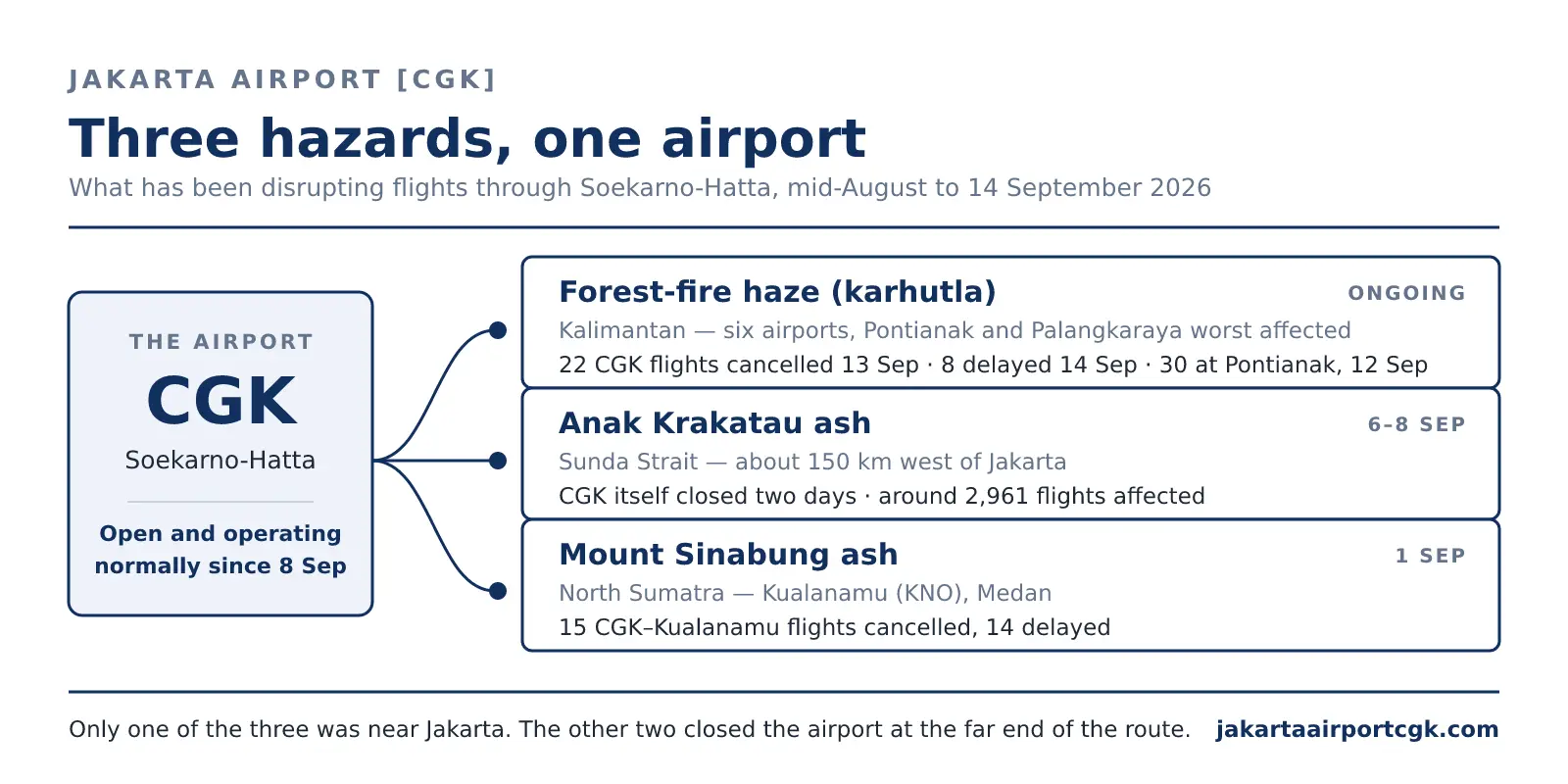
Status, Monday 14 September 2026: CGK is open and running normally. Kalimantan routes are still being disrupted — 8 flights delayed today.
Soekarno-Hatta has operated a full schedule since it reopened just after midnight on Tuesday 8 September 2026. What is still disrupting flights is forest-fire haze at the destination. The airport reported 8 flights delayed as of 16:00 WIB on Monday 14 September after visibility fell below minima at Pontianak and Palangkaraya, a day after 22 CGK–Kalimantan flights were cancelled and 2 delayed on Sunday 13 September. Soekarno-Hatta has activated its Service Recovery Activation procedure. Anak Krakatau remains at Alert Level III (Siaga), so a repeat closure is possible but not forecast. If your flight is cancelled, you are owed a refund or free rebooking, not delay compensation. Check the live departures board before you travel.
If you are flying through Jakarta this month and your flight keeps moving, the airport is probably not the problem. Soekarno-Hatta has been fully operational since 8 September 2026. But flights through it have been cancelled almost continuously since mid-August, for three causes that have nothing to do with each other — and two of them are hundreds of kilometres from Jakarta. The single most useful habit right now is to stop checking the weather in Jakarta and start checking it at the other end of your route.
Four things went wrong in four weeks
Indonesian aviation had an unusually bad late August and early September in 2026. These overlapped, which is why the picture at CGK looked so confusing from the departures board.
| Cause | Where | When | Effect on CGK flights |
|---|---|---|---|
| Forest-fire haze (karhutla) | Kalimantan — Pontianak, Banjarmasin, Balikpapan, Sampit, Singkawang | Mid-August 2026 to now, recurring | Visibility at the destination falls below landing minima. 43 CGK–Kalimantan flights cancelled on 22–23 August; 30 cancelled at Pontianak alone on 12 September; 22 cancelled and 2 delayed across CGK–Kalimantan routes on 13 September; 8 delayed on 14 September. |
| Anak Krakatau ash | Sunda Strait, ~150 km west of Jakarta | 6–8 September 2026 | CGK itself closed for two days along with seven other airports. Roughly 2,961 flights affected by the Transport Ministry’s count. |
| Post-closure recovery backlog | CGK, and wherever the aircraft ended up | 8–9 September 2026 | Aircraft and crews out of position after the shutdown. Delays and scattered cancellations at Terminals 1, 2 and 3, unrelated to ash. |
| Mount Sinabung ash | North Sumatra — Kualanamu (KNO), Medan | 1 September 2026 | 15 CGK–Kualanamu flights cancelled and 14 delayed, affecting an estimated 5,350 passengers. |
Only the Anak Krakatau closure shut CGK itself, and that is covered in full in our timeline of the two-day closure. The rest of this article is about the disruption that is still happening.
Why the delays did not stop when the airport reopened
CGK reopened just after midnight on Tuesday 8 September. The departures boards that morning still showed cancellations across Terminal 1B for Lion Air, NAM Air and Sriwijaya Air, and delays throughout the day. The obvious assumption — that ash was still the problem — was wrong.
According to Yudistiawan, Assistant Deputy for Communication and Legal Affairs at the Soekarno-Hatta branch office, the delays sat almost entirely on the airlines’ side of the operation. Speaking to Kompas on 8 September, he put it down to carriers “making sure the aircraft is safe to use, doing the aircraft rotation, then preparing the crew”.
This is the part of a shutdown that outlasts the hazard. An airline schedule is a chain: the aircraft that flies Jakarta–Surabaya at 07:00 is the one that flew in from Denpasar the night before, and its crew are only legal for a set number of hours. Two days of closure leaves aircraft parked at the wrong airports and crews timed out in the wrong cities, and no amount of clear air fixes that instantly. By midday on 8 September the airport had put 324 flights through — 208 departures and 116 arrivals — while simultaneously processing the backlog of passengers asking to be rescheduled.
Yudistiawan also made a point worth remembering: nothing like this had happened at Soekarno-Hatta before, so the recovery was being improvised. That backlog has since cleared. The haze has not.
The disruption that is still running: haze over Kalimantan
Smoke from kebakaran hutan dan lahan (karhutla) — forest and land fires — has been closing Kalimantan airports since mid-August, and it is the reason CGK flights are still being cancelled today. It started before Anak Krakatau erupted and has continued after the volcano stopped mattering to Jakarta.
The clearest single day was Saturday 12 September 2026. Supadio International Airport in Pontianak cancelled 30 flights — 15 departures and 15 arrivals — after visibility dropped to between 300 and 500 metres and stayed there from 05:00 until 16:00 WIB. “Flight safety and security are the utmost priority in every operational decision,” Supadio’s general manager Maya Damayanti said. The airport handed out masks, water and snacks while the airlines processed refunds at their own counters. It did not clear the next day. Liputan6 reported that Supadio managed only 11 flights on the Saturday and 9 on the Sunday, and that 73 flights were delayed or rescheduled across 12–14 September. On Monday morning visibility was still 300 metres until 10:00 WIB, according to Supadio’s branch communication and CSR head, M. Joko Wahyudi.
Over that weekend the haze spread to a second Kalimantan airport that had not been on the CGK cancellation list before: Tjilik Riwut in Palangkaraya. Prokalteng recorded visibility there sliding from 800 metres at 07:30 WIB on Saturday 12 September to 500 metres by mid-afternoon and 450 metres at 15:30 — below the minimum. On Sunday the smoke thickened again from 15:00 and visibility hit 300 metres at 15:30 WIB, holding into the night. The airport’s general manager, Darmawan, named the airlines that cancelled: Super Air Jet, Garuda Indonesia and Batik Air.
At the Jakarta end that produced the worst single day of the Kalimantan haze so far. Soekarno-Hatta reported 22 flights cancelled and 2 delayed on Sunday 13 September 2026, counted up to 18:15 WIB, across three destinations — Supadio in Pontianak, Tjilik Riwut in Palangkaraya and H Asan in Sampit. The following day, Monday 14 September, the count as of 16:00 WIB was 8 flights delayed, this time on the Pontianak and Palangkaraya routes only. Both figures come from Yudistiawan, Assistant Deputy for Communication and Legal Affairs at the Soekarno-Hatta branch office. “We understand this affects passengers’ journeys,” he said, asking travellers to check their flight status through their airline’s own channels before setting out for the airport.
Note the shape of the two days: cancellations on the Sunday, delays on the Monday. A delay on a haze route is not automatically better news than a cancellation — it often means the airline is waiting to see whether the destination comes back above minima before it decides. Some of those aircraft go; some are cancelled several hours later.
At the Jakarta end, the pattern goes back weeks. Kompas reported 43 CGK–Kalimantan flights cancelled across 22 and 23 August 2026 — 18 on the Saturday and 25 on the Sunday — across five destinations. Earlier in August, on the 16th, 18th and 19th, TransNusa and Super Air Jet cancelled Jakarta–Singkawang services in both directions with visibility running at 2,000 to 3,000 metres.
Then on 2 September, seven CGK flights to Pontianak went wrong in three different ways: four delayed, two cancelled, and one that departed Jakarta and turned back. The airport spokesman’s account was blunt — “four haven’t departed yet, one already left then came back, and two were decided not to depart”. Those seven were spread across all three terminals.
The six Kalimantan routes to watch
Soekarno-Hatta named five destinations when it reported the August cancellations; Palangkaraya became the sixth over the weekend of 12–13 September. If your booking is on one of them, build in more slack than you normally would.
| Destination | What has happened there |
|---|---|
| Pontianak (PNK) | Supadio International. The worst affected. Visibility 300–500 m for eleven hours on 12 September 2026 and 30 flights cancelled; only 11 flights operated that day and 9 on the Sunday. Still 300 m until 10:00 WIB on Monday 14 September. |
| Palangkaraya (PKY) | Tjilik Riwut. Added to the list on 12–13 September 2026. Visibility fell from 800 m to 450 m through Saturday, then to 300 m at 15:30 WIB on Sunday. Super Air Jet, Garuda Indonesia and Batik Air all cancelled. |
| Singkawang (SKJ) | West Kalimantan. Jakarta–Singkawang services by TransNusa and Super Air Jet were repeatedly cancelled through mid-August. |
| Banjarmasin (BDJ) | South Kalimantan. Named among the five routes cancelled from CGK on 22–23 August 2026. |
| Balikpapan (BPN) | East Kalimantan. Also a transfer point — haze at Banjarmasin and Pontianak delayed onward flights out of Balikpapan by one to four hours. |
| Sampit (SMQ) | Central Kalimantan, H Asan airport. One of the 22–23 August cancellations, and named again among the three destinations behind the 13 September cancellations. |
Why smoke grounds an aircraft
Haze does not damage an aircraft the way volcanic ash does. Ash is pulverised rock and glass that melts inside a running engine; smoke is not going to do that. The problem with haze is simpler and entirely about the last few hundred metres of the approach.
Every runway approach has a published minimum visibility below which it cannot legally be flown. When smoke drops the visibility at Supadio to 300 metres, the approach is off — not because the aircraft cannot handle it, but because the rules that keep landings survivable say so. The Director General of Civil Aviation, Lukman F Laisa, framed it exactly that way in August: safety is the top priority, and airlines must adjust when visibility fails to meet requirements.
What makes haze worse than ordinary fog is persistence. Radiation fog burns off as the sun climbs. Smoke from burning peat keeps being produced, sits low, and can hold for the whole working day — which is what happened at Pontianak on 12 September, eleven hours below minima. That is why haze cancellations tend to take out a day’s worth of rotations rather than pushing a single departure back an hour.
It also explains the return-to-base on 2 September. Visibility at the destination can deteriorate after an aircraft has already left Jakarta, and at that point the only options are to hold, divert, or go back. On a haze-affected route, an on-time departure is not the same as an arrival.
How long does this go on?
No one has put a date on it, and treat anyone who does with suspicion. What is on the record is the fire weather. BMKG, Indonesia’s meteorological agency, put the Fire Weather Index for the region in the high to very high band for 11–17 September 2026 — which covers the rest of this week. It has recorded roughly 2,526 hotspots in Central Kalimantan and 2,102 in West Kalimantan this season, the two provinces containing Palangkaraya and Pontianak respectively.
BMKG is running weather-modification operations over West Kalimantan to try to induce rain, and says they have produced results. Against that, the agency expects El Niño conditions to persist into early 2027, which lengthens the dry spells between rain. The practical reading for a traveller is that this is a season rather than an incident: individual days will clear, but the risk on Kalimantan routes does not disappear because one morning was fine.
Supadio has since brought the airlines, AirNav Indonesia and BMKG into an Airport Collaborative Decision Making (A-CDM) arrangement so that visibility data and schedule decisions reach passengers faster. That should shorten the gap between a decision being made and it showing on your airline app — it does not make the flight operate.
And the volcanoes are not finished
Two separate volcanoes hit CGK schedules in September 2026. Mount Sinabung in North Sumatra erupted first: on 1 September, ash closed Kualanamu airport near Medan, and Kompas reported 15 CGK–Kualanamu flights cancelled and 14 delayed, with an estimated 5,350 passengers affected in a single day. That had nothing to do with Anak Krakatau, which erupted four days later.
Anak Krakatau remains at Alert Level III (Siaga), the second-highest of Indonesia’s four levels, with a 3 km exclusion zone around the crater. PVMBG, the volcanology agency, still recorded eruptions in its 10–11 September observation period and says the probability of further eruptions remains high. Whether that closes CGK again is not really a question about the volcano — it is a question about wind direction, which is why nobody will forecast it for you.
What you are owed, and what you are not
Both haze and volcanic ash are treated as extraordinary circumstances outside the airline’s control. That distinction decides everything about what you can claim.
- No statutory delay compensation. The fixed payments that apply to an airline’s own operational delays do not apply here. Asking for them will waste your time at the counter.
- A refund or rebooking, yes. For the August haze cancellations, the Director General of Civil Aviation said affected passengers received full refunds and free date changes of up to seven days. During the Anak Krakatau closure, Transport Minister Dudy Purwagandhi instructed every airline to offer a 100% refund or rebooking onto another service.
- Duty of care at the airport. Supadio provided masks, drinking water, snacks and extra seating on 12 September. At the Jakarta end, Soekarno-Hatta activated its Service Recovery Activation (SRA) procedure on both 13 and 14 September, which in practice means food and drink in the waiting areas while the airlines work through affected passengers. This is service recovery, not compensation, and it is discretionary rather than a fixed entitlement — but it is routinely offered. InJourney Airports runs a contact centre on 172 for airport-side questions; ticket questions still go to the airline.
- Ask by the right name. Say “refund” or “reschedule” rather than “compensation”, and go through the airline’s own channel — its app, call centre or sales office — rather than queuing at the airport, which is usually slower.
What to do if you are flying through CGK this month
- Check the destination, not Jakarta. This is the single change that would have helped most of the passengers caught out since mid-August. CGK being clear tells you almost nothing about whether your flight will operate.
- Confirm with the airline within a few hours of departure. Soekarno-Hatta’s spokesman has made this request repeatedly. Cancellations on haze routes are decided the same morning, not days ahead.
- On Kalimantan routes, prefer a later departure. Visibility has generally been at its worst around dawn. This is a tendency rather than a rule — Pontianak stayed below minima until 16:00 WIB on 12 September — but a mid-afternoon departure has had better odds than an early-morning one.
- Do not book a tight onward connection. A return-to-base or a same-day cancellation will destroy a short transfer window, and the disruption is not covered by the usual missed-connection protections when it is classed as force majeure.
- Keep the overland option in mind. For domestic trips within Java, a train or bus is immune to all of this. Our airport-to-city transport guide covers the connections out of CGK.
- Check your insurance wording. Many basic policies exclude volcanic disruption by name, and some exclude haze as a foreseeable seasonal event. Read the exclusions rather than assuming.
FAQ
Is Jakarta Airport (CGK) open right now?
Yes. Soekarno-Hatta reopened just after midnight on Tuesday 8 September 2026 after a two-day closure caused by Anak Krakatau, and the airport itself has been operating normally since. Individual flights are still being cancelled, but the cause is now almost always conditions at the other end of the route rather than anything at CGK.
Why were flights still delayed after the airport reopened?
Because the aircraft and crews were in the wrong places. Yudistiawan, Assistant Deputy for Communication and Legal Affairs at the Soekarno-Hatta branch office, told Kompas on 8 September 2026 that the delays were down to airline preparation rather than ash: confirming each aircraft was safe to fly, working through aircraft rotations, and positioning crew. By midday on 8 September the airport had operated 324 flights — 208 departures and 116 arrivals. He also noted this was the first closure of its kind in the airport’s history, so the recovery had no playbook.
Which CGK routes are most likely to be cancelled now?
Flights to Kalimantan. Forest-fire haze (karhutla) has repeatedly pushed visibility at the destination airports below the legal minimum. Soekarno-Hatta has now seen cancellations on six Kalimantan routes: Banjarmasin (BDJ), Balikpapan (BPN), Pontianak (PNK), Palangkaraya (PKY), Sampit (SMQ) and Singkawang (SKJ). Pontianak is the worst affected; Palangkaraya joined the list over the weekend of 12–13 September 2026. On Sunday 13 September the airport reported 22 CGK–Kalimantan flights cancelled and 2 delayed, and on Monday 14 September a further 8 flights delayed.
How bad has the haze been at Pontianak?
On Saturday 12 September 2026, Supadio International Airport in Pontianak cancelled 30 flights — 15 departures and 15 arrivals — after visibility fell to between 300 and 500 metres from 05:00 until 16:00 WIB. Supadio’s general manager, Maya Damayanti, said flight safety and security were the priority in every operational decision. It did not clear over the weekend: Liputan6 reported that Supadio operated only 11 flights on the Saturday and 9 on the Sunday, and that 73 flights were delayed or rescheduled across 12–14 September. On Monday 14 September visibility was still 300 metres until 10:00 WIB, according to Supadio’s branch communication head M. Joko Wahyudi.
What is Service Recovery Activation, and what do I get?
It is the procedure Soekarno-Hatta switches on when a disruption starts stacking up passengers in the terminals. The airport confirmed it activated SRA on both 13 and 14 September 2026 for the haze-affected Kalimantan flights. In practice it means food and drink handed out in the waiting areas while the airlines work through the affected passengers, plus coordinated information between the airport, the airlines and AirNav. It is service recovery, not compensation — your refund or rebooking still comes from the airline. InJourney Airports runs a contact centre on 172 for airport-side questions.
How long is the Kalimantan haze likely to last?
Nobody has given a date, and you should be sceptical of anyone who does. BMKG, the meteorological agency, put the Fire Weather Index for the region in the high to very high band for 11–17 September 2026, and has recorded roughly 2,526 hotspots in Central Kalimantan and 2,102 in West Kalimantan this season. BMKG is running weather-modification operations over West Kalimantan to try to induce rain. The agency also expects El Niño conditions to persist into early 2027, which means longer dry spells. The honest answer is that this is a season, not an incident.
Why does haze cancel a flight when fog usually does not?
It is not the smoke in the air en route that matters — it is how far the pilot can see on final approach. Airports publish a minimum visibility for landing, and below it the approach is not legal regardless of how capable the aircraft is. Haze from peat and land fires is dense, persistent and sits low, and unlike morning fog it does not reliably burn off by mid-morning. At Supadio on 12 September the visibility stayed below minima for eleven straight hours.
Can my flight leave Jakarta on time and still not arrive?
Yes, and this has already happened. On 2 September 2026 seven CGK flights to Pontianak were disrupted by haze: four were delayed, two were cancelled, and one departed and then turned back to Jakarta. A return-to-base is the standard outcome when conditions at the destination deteriorate after pushback. An on-time departure is not a guarantee of arrival on haze-affected routes.
Was a volcano other than Anak Krakatau involved?
Yes. On 1 September 2026, a week before the Anak Krakatau closure, ash from Mount Sinabung in North Sumatra closed Kualanamu airport near Medan. Kompas reported 15 CGK–Kualanamu flights cancelled and 14 delayed that day, affecting an estimated 5,350 passengers. That disruption was entirely separate from the Anak Krakatau event and from the Kalimantan haze.
Am I owed compensation for a haze or ash cancellation?
Not delay compensation. Volcanic ash and haze are treated as extraordinary circumstances outside the airline’s control, so the statutory delay payments do not apply. A refund does. For the August 2026 haze cancellations, Director General of Civil Aviation Lukman F Laisa said affected passengers received full refunds and free date changes of up to seven days. During the Anak Krakatau closure, Transport Minister Dudy Purwagandhi instructed airlines to offer a 100% refund or free rebooking. Ask your airline for the refund or rebooking by name.
Is Anak Krakatau still a risk to CGK flights?
It remains a live one. PVMBG has kept Anak Krakatau at Alert Level III (Siaga), the second-highest of Indonesia’s four levels, with a 3 km exclusion zone, and eruptions were still being recorded in the 10–11 September 2026 observation period. The agency says the probability of further eruptions is still high. Whether that affects CGK again depends on wind direction as much as on the volcano.
What should I actually do before flying out of CGK?
Check the weather at your destination, not just at Jakarta, and check your flight status on the airline’s own app or website within a few hours of departure rather than relying on the booking confirmation. Soekarno-Hatta’s spokesman has repeatedly asked passengers to confirm with the airline before travelling to the airport. If you are flying to Kalimantan, an earlier booking is worth reconsidering — haze has been at its worst around dawn.
See also
- Live departures and live arrivals — the fastest way to check whether your flight is still operating.
- Anak Krakatau and the CGK closure — the full timeline of the two-day shutdown, the diversion airports, and the refund order.
- Airport-to-city transport guide — every CGK option compared, useful when a cancellation leaves you needing to get out of the airport.
- Terminals & services — where to wait, eat and charge if your departure slips by several hours.