Anak Krakatau Eruption Closed Jakarta Airport (CGK) for Two Days — Full Timeline and What It Means Now
Status: CGK is open and operating normally, with route contingencies on standby.
Soekarno-Hatta reopened just after midnight on Tuesday 8 September 2026 after a two-day closure. Anak Krakatau remains at Alert Level III (Siaga) with a 3 km exclusion zone, and on Friday 11 September AirNav Indonesia said it is holding flight re-routing plans ready in case ash drifts back across the corridors — though no domestic route needed one at that point. Air quality outdoors at the airport was still above health limits in the week after the closure. If your flight was cancelled during the shutdown, the Transport Ministry ordered airlines to offer a 100% refund or free rebooking. Always check the live departures board before you travel.
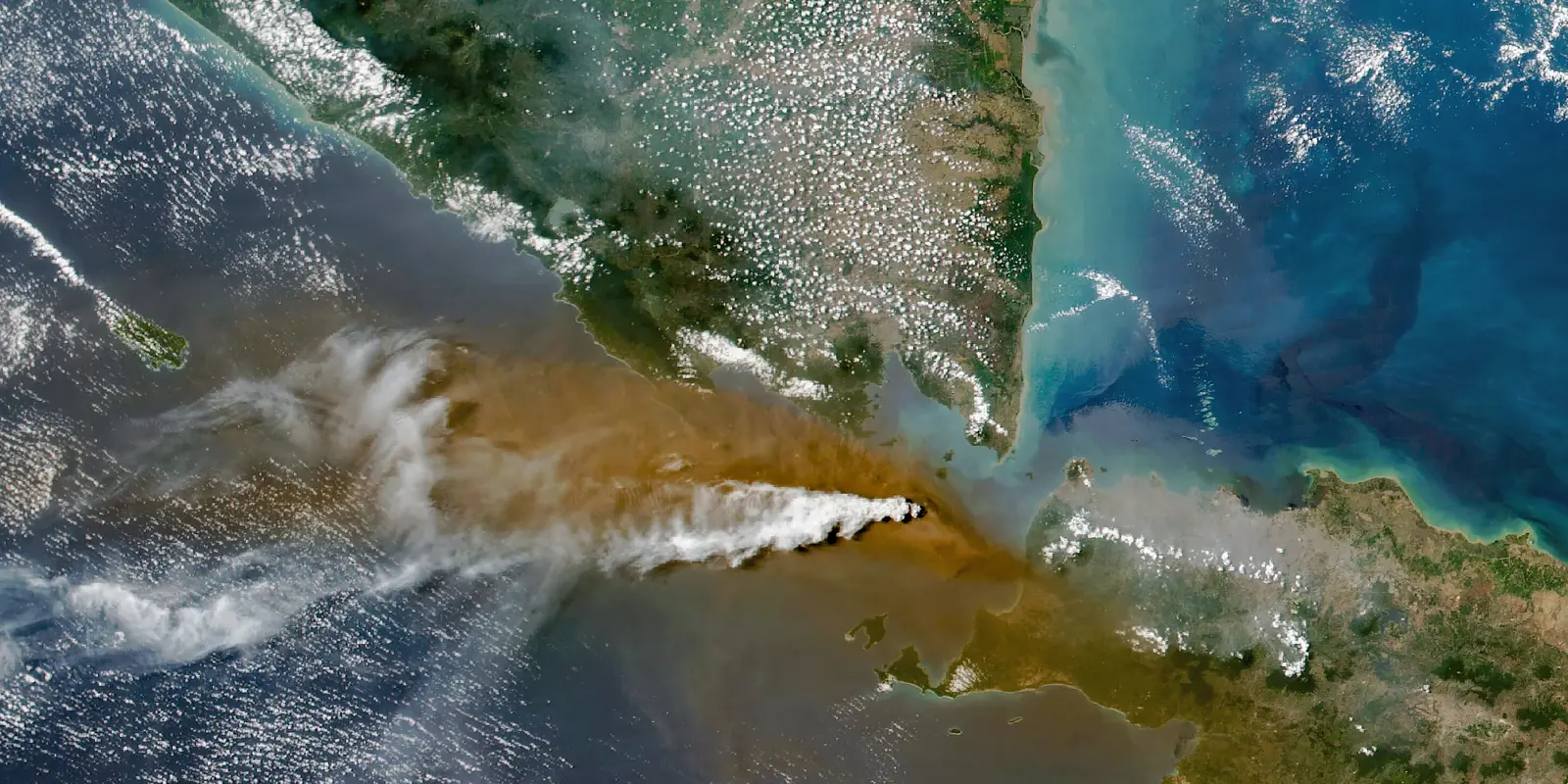
For two days in early September 2026, Indonesia’s busiest airport simply stopped. Ash from Anak Krakatau — the volcano sitting in the Sunda Strait roughly 150 km west of the capital — drifted east over Banten and Jakarta and forced Soekarno-Hatta International Airport (CGK) to close along with seven other Indonesian airports. Between 2,961 and 4,174 flights and 341,000 to 456,000 passengers were caught in it, depending on whose count you take. Here is what happened, where the diverted flights went, what travellers were owed, and what it is worth knowing if you have a CGK flight booked.
How the closure unfolded
| When (WIB) | What happened |
|---|---|
| Fri 4 Sep, 23:07 WIB | Anak Krakatau begins a continuous explosive eruption in the Sunda Strait, about 150 km west of Jakarta. |
| Sat 5 Sep | The eruption sustains a continuous column. Ash reaches roughly 6,000 m over the Java side and up to 15,000 m toward Sumatra and Banten. |
| Sun 6 Sep, 00:04 WIB | The continuous eruption ends after 25 hours. Ashfall blankets parts of Jakarta and West Java; schools move classes online. |
| Sun 6 Sep, 01:30 WIB | Volcanic ash is detected at Soekarno-Hatta. AirNav closes the airspace under NOTAM A3344/26 and CGK suspends operations; seven other airports follow, including Halim Perdanakusuma. |
| Sun 6 Sep, 21:00 WIB | The first free buses leave Soekarno-Hatta for the alternative airports. Registration posts open in Terminals 1, 2 and 3. |
| Mon 7 Sep, 18:00 WIB | Closures are extended through Monday evening as ash lingers in the corridors. Semarang, Surabaya and Yogyakarta take diverted traffic. Garuda lands its Jeddah and Amsterdam services at Kertajati; the Transport Ministry orders 100% refunds or rebooking for cancelled tickets. |
| Tue 8 Sep, just after midnight | CGK, Halim and three regional airports reopen after route safety checks. 178 aircraft parked at CGK are inspected for ash contamination before flying. |
| Tue 8 Sep, afternoon | CGK has operated 324 flights (208 departures, 116 arrivals), heading for a projected 896 movements and about 113,000 passengers. It closes the day on 875 flights — 436 departures and 439 arrivals. |
| Wed 9 Sep | CGK schedules 966 flights (722 domestic, 244 international) and about 131,495 passengers — back to a normal day’s volume. |
| Fri 11 Sep, 06:00 WIB | Badan Geologi’s evaluation records 14 Strombolian eruptions since the continuous phase ended. Alert Level III (Siaga) stays in place. |
| Fri 11 Sep | AirNav Indonesia says re-routing plans are ready but no domestic route currently needs them, because wind is carrying ash away from CGK. The Health Ministry reports PM2.5 above safe limits in outdoor areas of the airport. |
Why ash closes an airport 150 km away
The instinct is to ask how a volcano that far away can ground flights in Jakarta. The answer is that distance is almost beside the point — wind direction is what matters. Anak Krakatau threw ash high into the atmosphere, and the prevailing winds carried it east, directly over the Jakarta metropolitan area.
Volcanic ash is not soft like wood ash. It is pulverised rock and volcanic glass, hard and abrasive, and it melts at temperatures below those inside a running jet engine. Fly through a cloud of it and the glass re-solidifies on turbine blades, chokes the airflow and can shut the engine down in flight. It also sandblasts windscreens and blocks the sensors that feed an aircraft’s airspeed instruments. There is no safe way to fly through it and no radar that reliably sees it, which is why the standard response is simply to stop.
That is also why reopening took longer than the ash took to clear. Before CGK could resume, air corridors had to be re-surveyed, ground crews had to sweep residual ash off runways and taxiways, and the 178 aircraft parked at the airport during the shutdown each had to be inspected for contamination in engines and sensors.
The scale of the disruption
- 8 airports closed, including Soekarno-Hatta and Halim Perdanakusuma in Jakarta.
- ~2,900 flights cancelled, delayed or diverted — more than 900 of them at CGK alone.
- 340,000+ passengers affected, with over 270,000 stranded at the peak of the disruption.
- Ash plumes to ~15,000 m (about 50,000 ft) on the Sumatra side, and roughly 6,000 m over Java.
- Two days of closure at CGK, from Sunday morning to just after midnight on Tuesday.
Those totals should be read as approximations, because the official counts do not match each other. Indonesian authorities were citing “more than 2,300 flights” and around 270,000 passengers for the period up to reopening. The Transport Ministry later settled on 2,961 flights and about 341,000 passengers across the eight airports. InJourney Airports, counting 5–8 September across its own network, puts it higher still at 4,174 flights and 455,754 passengers. The gap is probably a matter of what counts as “affected” and over which dates — a knock-on delay two days later is a judgement call — but nobody has published a reconciled figure, so treat any single number with caution.
Four of the eight closed airports are InJourney’s: Soekarno-Hatta, Halim Perdanakusuma, Husein Sastranegara in Bandung and Raden Inten II in Lampung. “The safety and security of passengers remains the priority in every operational decision,” InJourney chief executive Maya Watono said after the network reopened.
The response leaned on the rest of the network. Transportation Minister Dudy Purwagandhi designated Semarang and Surabaya as alternative landing points, with six airports across East Java, Central Java and Yogyakarta prepared to absorb diverted traffic. Free buses ferried passengers between cities, and immigration waived overstay penalties for foreign visitors whose flights had been cancelled. “We understand that this situation affects passengers’ travel plans,” airport spokesman Yudhistiawan said during the closure. “From the start of the temporary closure, we have focused on ensuring that passengers’ needs continue to be met.”
Where the flights actually went
When CGK shut, the inbound aircraft still had to land somewhere. Transportation Minister Dudy Purwagandhi named five alternative airports, all instructed to operate 24 hours for the duration. If you were on a CGK-bound flight that week, this is where you most likely ended up.
| Airport | Where | What it took |
|---|---|---|
| Kertajati (KJT) | Majalengka, West Java | Garuda Indonesia arrivals from Jeddah and Amsterdam. The nearest of the five to Jakarta, and the busiest it has been in years. |
| Juanda (SUB) | Surabaya, East Java | Singapore Airlines services, plus general international and domestic overflow. |
| Yogyakarta International (YIA) | Kulon Progo, Yogyakarta | Singapore Airlines services and diverted domestic traffic. |
| Jenderal Ahmad Yani (SRG) | Semarang, Central Java | Domestic overflow; named by the minister as a primary alternative landing point. |
| Adi Soemarmo (SOC) | Solo, Central Java | Domestic overflow, operating around the clock for the duration. |
The lists do not agree at the edges. The ministry’s own briefings named those five; a detikcom photo report counted six, adding Adisutjipto in Yogyakarta; and InJourney Airports’ account of the week also mentions Bali’s I Gusti Ngurah Rai taking traffic. The five above are the ones every source agrees on.
“We encourage the use of alternative airports so that we can distribute passengers coming home, and they do not have to stay long in their departure countries,” Dudy said at Soekarno-Hatta on Monday 7 September.
Getting from a diversion airport back to Jakarta
Landing in Solo when you had booked Jakarta is only half a problem solved. InJourney Airports and the airlines put on free buses and trains linking Jakarta with Yogyakarta, Solo, Semarang and Surabaya. The first buses pulled out of Soekarno-Hatta at 21:00 WIB on Sunday 6 September, a little under twenty hours after the airport closed.
Passengers registered at posts set up inside Terminals 1, 2 and 3 — the verification desk at Terminal 1C handled much of the traffic. The same Service Recovery Activation covered food, drinks and set-aside rest areas in the terminals for passengers waiting it out.
One gap worth noting: Kertajati, which took Garuda’s long-haul arrivals, does not appear in the published lists of free bus and train destinations. We have not seen an official explanation, and passengers landing there may have been handled by their airline directly. If a future closure sends you to an airport outside that four-city list, ask your airline about onward transfer rather than assuming it is arranged.
None of this is a standing service. It was assembled for that specific closure, and a future one would need the same decision taken again.
Your ticket: a full refund, not compensation
These two get confused, and the difference matters. Volcanic ash is an extraordinary circumstance beyond the airline’s control, so statutory delay compensation does not apply. A refund is a different thing entirely, and it does.
On Monday 7 September the Transport Ministry instructed every airline to give passengers whose flights were cancelled a straight choice: a 100% refund, or rebooking onto another service. “The government ensures that passengers who choose to cancel their flight are entitled to a one-hundred-per-cent refund,” Dudy Purwagandhi said. The instruction was issued through the Directorate General of Civil Aviation under Lukman F. Laisa.
The practical lesson for next time: if a closure cancels your flight, you are not choosing between waiting and losing your money. Go to the airline — app or call centre, not the airport desk — and ask for the refund or the rebooking explicitly.
What a re-route actually means for your flight
Speaking at AirNav Indonesia’s office in Tangerang on Friday 11 September 2026, Capt. Nurcahyo Utomo, the agency’s Director of Safety, Security and Standardisation, said air traffic control is watching the volcano around the clock alongside the volcanology agency (PVMBG) and the meteorology agency (BMKG) — tracking not just the eruptions themselves but wind direction and where ash is likely to travel.
If ash threatens a corridor, the standard response is a re-route, and that word sounds more dramatic than it is. It means nudging aircraft around the affected block of airspace, not sending them somewhere else entirely. The example Nurcahyo gave: a Jakarta–Palembang service shifted slightly north of its usual track near Tanjung Karang. On a domestic sector that is a difference measured in minutes.
As of that Friday, AirNav said no domestic route was being re-routed, because the wind was carrying ash away from Soekarno-Hatta. The greater exposure, according to the agency, sits with international traffic crossing the region — the long-haul corridors between Australia and the Middle East pass close to the Sunda Strait, and those are the flights that would take the longer deviations.
The timing matters more than the distance. AirNav refreshes aeronautical information on a six-hour cycle as standard, and can issue an update within an hour if conditions change materially. That is why a NOTAM can appear with very little notice: during the closure itself, AirNav issued NOTAMs A3341/26, A3342/26 and A3344/26 within a few hours of each other on 6 September, coordinated through its Indonesia Network Management Center (INMC).
Capacity is the other constraint. CGK is worked at up to 81 movements an hour, and when it reopened the first wave was deliberately weighted toward departures — 61 out against 20 in — because the parking stands were full of the aircraft that had sat out the shutdown. A backlog at CGK clears by emptying the apron first, which is worth knowing if you are the inbound passenger waiting for that aircraft.
The practical upshot: a re-route is not a cancellation, and it is not something you need to act on. What it does tell you is that the decision cycle is short. If you are flying in the next few weeks, check your flight status close to departure rather than the night before.
Safe to fly is not the same as safe to breathe
The test that decides whether aircraft can operate is the paper test — sheets left out to catch ash particles. Those came back negative at Soekarno-Hatta, Halim, Husein Sastranegara and Budiarto before the airports reopened. Air quality for people on the ground is a separate question, and it did not clear as quickly.
Health Ministry monitoring on 8–9 September, released on 11 September, found PM2.5 of 63 µg/m³ at the DAMRI bus terminal at Soekarno-Hatta, against a safe threshold of 25 µg/m³. Several other outdoor points at and around the airport were also above the limit for PM2.5 and PM10. “The airport authority uses paper tests for flight safety, but it turns out particulate matter for health is still high,” Deputy Health Minister Dante Saksono Harbuwono said.
The readings that exceeded the limit were outdoors, which is where you are exposed at CGK: the kerbside drop-off, the bus bays, the open car parks and the walk between terminals. The ministry’s advice is to wear a mask for outdoor time in affected areas — sensible if you have asthma or another respiratory condition, are pregnant, or are travelling with young children or elderly relatives. We have not seen updated readings published since; if you are sensitive to air quality, treat the outdoor areas as the risk and do not assume the numbers have come down.
Where things stand now
CGK has been running a normal schedule since 8 September. The volcano, however, has not gone quiet. Anak Krakatau sits at Alert Level III (Siaga), the second-highest of Indonesia’s four levels, and the volcanology agency maintains a 3 km exclusion zone around the crater while warning that the probability of further eruptions remains high. The continuous eruption has settled back into intermittent Strombolian activity — occasional spurts rather than a sustained column.
Badan Geologi’s evaluation to 06:00 WIB on Friday 11 September recorded 14 Strombolian eruptions since the continuous phase ended at 00:04 WIB on 6 September, after 25 hours that began at 23:07 WIB on 4 September. The trend is downward and the alert level was still III on Saturday 12 September, but the agency has not lowered it, and magma supply is still being detected. In plain terms: the eruption that closed the airport is over; the eruption sequence is not.
For travellers that means the risk is real but not constant. A future closure would need a fresh eruption and winds pointing at Jakarta at the same time. Neither is forecastable weeks ahead, which is an argument for flexibility rather than for changing your plans.
If ash disrupts your CGK flight
- Check before you leave for the airport. During a closure the terminal is the worst place to be. The live departures and arrivals boards update faster than most airline notification emails.
- Contact your airline directly. Rebooking queues at the airport were hours long; app and call-centre channels moved faster. Airlines offered free rebooking and refunds throughout this closure.
- Ask for the refund by name. Statutory delay compensation does not apply to volcanic ash, but a refund does — the Transport Ministry ordered 100% refunds or free rebooking for cancelled flights during this closure. Do not accept a voucher if you wanted the money back.
- Consider the overland option. When Jakarta closed, flights kept running from Kertajati, Semarang, Solo, Surabaya and Yogyakarta, and free buses and trains linked four of those cities to Jakarta. For domestic trips, a train or bus to a working airport can beat waiting out a closure.
- Book insurance that names natural disasters. Many basic policies exclude volcanic disruption specifically. Check the wording rather than assuming.
- If you are already overseas and stranded, ask about overstay relief. Indonesian immigration granted it during this event; it is not automatic, but it is routinely offered when closures are officially declared.
FAQ
Is Jakarta Airport (CGK) open now?
Yes. Soekarno-Hatta reopened just after midnight on Tuesday, 8 September 2026, and has been running a normal schedule since. The closure lasted roughly two days, from Sunday 6 September to the early hours of Tuesday 8 September.
Why did a volcano 150 km away close Jakarta airport?
Distance matters less than wind. Volcanic ash is made of fine, abrasive rock and glass that melts inside a jet engine and can cause it to flame out. Anak Krakatau pushed ash up to about 15,000 metres, and winds carried it east over Banten, Jakarta and West Java. Once ash was detected in the airspace and on the ground at CGK, the airport had no safe option but to close.
How many flights and passengers were affected?
It depends whose count you use. The Transport Ministry put it at 2,961 flights and about 341,000 passengers across the eight airports that closed. InJourney Airports, counting 5–8 September across its own network, gives a higher 4,174 flights and 455,754 passengers. Soekarno-Hatta alone accounted for over 900 disrupted flights. No single reconciled figure has been published.
Where were CGK flights diverted to?
The Transport Ministry designated five alternative airports, all running 24 hours: Kertajati (BIJB) in Majalengka, West Java; Jenderal Ahmad Yani in Semarang; Yogyakarta International Airport; Juanda in Surabaya; and Adi Soemarmo in Solo. Garuda Indonesia moved its Jeddah and Amsterdam arrivals to Kertajati, and Singapore Airlines used Surabaya and Yogyakarta. Some reports also list Adisutjipto in Yogyakarta and Bali’s I Gusti Ngurah Rai as receiving traffic.
Was there free transport from the diversion airports to Jakarta?
Yes. InJourney Airports and the airlines laid on free buses and trains between Jakarta and Yogyakarta, Solo, Semarang and Surabaya, with the first buses leaving at 21:00 WIB on Sunday 6 September 2026. Passengers registered at posts set up in Terminals 1, 2 and 3 at Soekarno-Hatta. This was a one-off arrangement for that closure, not a standing service.
Is Anak Krakatau still erupting?
Yes, intermittently. The continuous 25-hour eruption ended at 00:04 WIB on 6 September, but Badan Geologi counted 14 smaller Strombolian eruptions between then and 06:00 WIB on Friday 11 September. The volcano remains at Alert Level III (Siaga), the second-highest of Indonesia’s four levels, with a 3 km exclusion zone around the crater, and the volcanology agency says the probability of further eruptions is still high.
Will my flight be re-routed because of the volcano?
Possibly, and it is not something to worry about. AirNav Indonesia says a re-route means nudging an aircraft around the affected airspace rather than a major detour — the example it gave was a Jakarta–Palembang flight shifting slightly north near Tanjung Karang, a difference of minutes. As of 11 September 2026 no domestic route was being re-routed, because winds were carrying ash away from Jakarta. International long-haul corridors crossing the region, including Australia to the Middle East, would take the longer deviations.
Is the air at Soekarno-Hatta safe to breathe?
For flight safety, yes — paper tests for volcanic ash at CGK came back negative before the airport reopened. For health, outdoor air at the airport was still poor afterwards: Health Ministry monitoring on 8–9 September 2026 recorded PM2.5 of 63 µg/m³ at the DAMRI bus terminal, against a safe limit of 25 µg/m³. The ministry advised wearing a mask outdoors in affected areas. The high readings were in outdoor areas such as kerbsides, bus bays and car parks.
Could CGK close again?
It is possible but not predictable. Closures depend on whether a fresh eruption coincides with winds blowing ash toward Jakarta. If you are flying through CGK in the coming weeks, check your airline’s status page and the live flight board before leaving for the airport, and consider travel insurance that covers natural-disaster disruption.
What happens to my ticket if ash closes the airport?
Volcanic ash is treated as an extraordinary circumstance outside the airline’s control, so statutory delay compensation does not apply. A refund does. On 7 September 2026 Transport Minister Dudy Purwagandhi instructed every airline to give passengers whose flights were cancelled the choice of a 100% refund or rebooking onto another service. Immigration also granted overstay relief to foreign visitors whose flights were cancelled. Contact your airline directly rather than waiting at the airport.
See also
- Live departures and live arrivals — the fastest way to check your flight status.
- Airport-to-city transport guide — every CGK option compared, useful when you need to leave the airport in a hurry.
- Indonesia’s busiest airports 2026 — why a CGK closure ripples across the whole network.
- Terminals & services — where the bus bays, car parks and walkways are, if you are trying to limit time outdoors.