Haze Turns a CGK–Jambi Flight Back to Jakarta. Check Your Destination, Not CGK
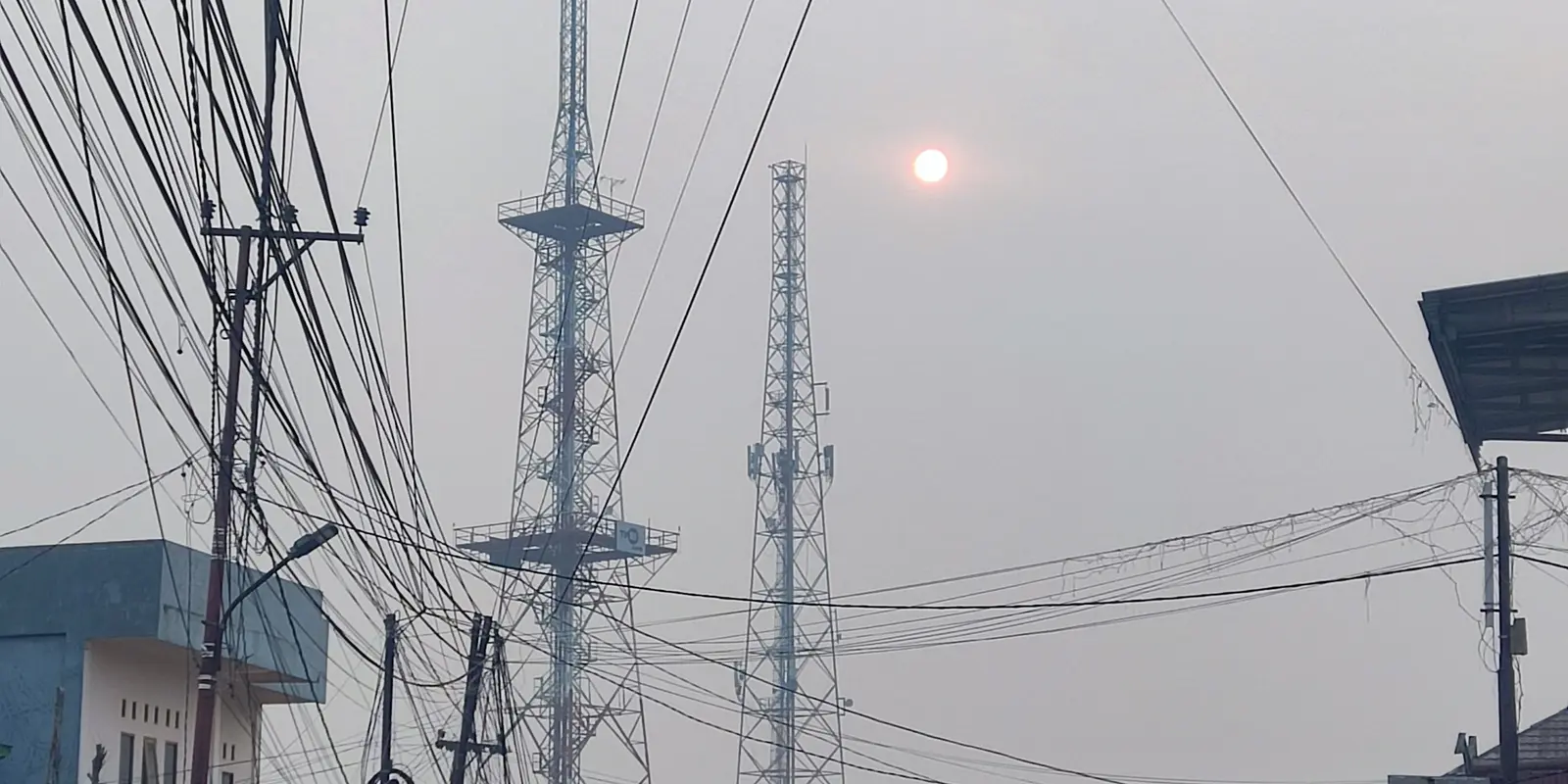
Status as last reported, Wednesday 30 September 2026: CGK is open and normal. Jambi was not formally closed, but nothing could land there on Wednesday morning.
One CGK–Jambi flight returned to Jakarta and two more were held at CGK. Visibility at Jambi changes hour by hour and is usually worst in the morning, so the situation on the day you fly is what counts. Check your flight on the airline’s own app, and on our live departures board, a few hours before you set off for the airport.
If you are flying from Jakarta to Jambi, Palembang or anywhere else in southern Sumatra in the next few weeks, the weather in Jakarta tells you almost nothing. On Wednesday morning a Batik Air flight left Soekarno-Hatta on schedule, reached Jambi, circled four times in smoke from forest and land fires, and flew its passengers back to CGK. On haze routes, a departure is not an arrival.
This is a new round of a problem the site has covered before. In mid-September the same kind of smoke was cancelling flights between CGK and Kalimantan — see why CGK flights kept getting cancelled in September for that episode and for the refund rules. This time the smoke is over Sumatra.
What happened on Wednesday 30 September
Smoke from kebakaran hutan dan lahan (karhutla) — forest and land fires — settled over Sultan Thaha Saifuddin Airport in Jambi (DJB) from the early morning until around midday. Three flights from CGK were affected, according to RRI, Detail.id, Liputan6, Jambi Independent, KR Sumsel and ANTARA:
| Flight | Route | What happened |
|---|---|---|
| Batik Air ID 6804 | CGK → Jambi (DJB) | Departed Jakarta, circled over Jambi four times, returned to CGK. |
| Citilink QG 960 | CGK → Jambi (DJB), scheduled 10:25 WIB | Held at CGK waiting for visibility at Jambi to improve. |
| Garuda Indonesia GA 126 | CGK → Jambi (DJB), scheduled 10:35 WIB | Held at CGK waiting for visibility at Jambi to improve. |
Batik Air did not divert to another Sumatran airport — it brought its passengers back to Soekarno-Hatta. That is what a return to base (RTB) means, and for a passenger it is the most frustrating outcome: a full flight’s worth of time, and you end up where you started. When the passengers eventually reached Jambi, and when the Citilink and Garuda flights finally left, has not been reported.
How low the visibility was, and why the reports differ
The airport’s general manager, Ardon Marbun, was quoted by several outlets, but the figures they carry are not the same:
- About 1,200 metres at 10:00 WIB — Liputan6, Jambi Independent, KR Sumsel and ANTARA.
- About 1,500 metres up to 10:00 WIB — RRI.
- Below 1,000 metres — Detail.id.
These are probably readings at different moments of a morning when the smoke was moving, and we cannot tell which is the lowest point. What all the sources agree on is that it was below what was needed to land. Liputan6 and KR Sumsel reported that conditions were still good enough for aircraft to take off from Jambi, but not for them to land — an approach needs the pilot to see the runway from much further out.
Was Jambi airport closed?
Not formally, as far as anything published shows. The airport’s own statements describe airlines “waiting for visibility to improve” and promise to keep airlines and passengers informed. Detail.id reported that no full closure was announced. Media Indonesia’s headline, on the other hand, called flights at the airport “totally paralysed”.
For someone flying in from Jakarta, the distinction does not matter much. An airport can be open for departures and still be impossible to land at.
This is the fourth bad day at Jambi since August
Wednesday was not a one-off. The same Batik Air flight number, ID 6804, was diverted to Batam five weeks earlier, and Palembang — the other big southern Sumatran airport served from CGK — has been hit twice in September. These are the incidents reported in the regional press:
| Date | Airport | What happened |
|---|---|---|
| Sun 23 Aug 2026 | Jambi (DJB) | Batik Air ID 6804 from Jakarta diverted to Batam with 138 people on board; Super Air Jet IU 842 diverted to Palembang. Visibility fell from 5,000 m to 1,000 m within an hour. |
| Tue 25 Aug 2026 | Jambi (DJB) | Garuda GA 128 diverted to Batam and Citilink QG 966 to Palembang as visibility fell to 800 m at 15:00 WIB. |
| Wed 16 Sep 2026 | Jambi (DJB) | Visibility 650–1,000 m around 10:00 WIB. Two arrivals from Jakarta delayed; a Batik Air departure to Jakarta left almost two hours late. |
| Thu 17 Sep 2026 | Palembang (PLM) | Visibility down to 700 m in the morning; four arriving aircraft held off landing. |
| Fri 25 Sep 2026 | Palembang (PLM) | Visibility about 700 m. Six flights affected; Super Air Jet IU 922 from Jakarta returned to CGK. |
| Wed 30 Sep 2026 | Jambi (DJB) | Batik Air ID 6804 returned to CGK; Citilink and Garuda held in Jakarta. Pekanbaru hazy but operating normally. |
Two patterns stand out. Most of the disruption has hit morning arrivals from Jakarta, though not all of it — the 25 August diversions were in the afternoon. And when a Jakarta flight cannot land, the outcome has varied: it may hold over the airport, divert to Batam or Palembang, or come back to CGK. You will not know which until it happens.
Palembang and Pekanbaru
Palembang (PLM). On Friday 25 September 2026, visibility at Sultan Mahmud Badaruddin II fell to about 700 metres. Six flights were affected — three arrivals and three departures, all on the Jakarta route — and Super Air Jet IU 922 from CGK returned to Jakarta, according to ANTARA and JPNN. ANTARA also reported a PM2.5 reading of 515 micrograms per cubic metre in the city at 11:00 WIB from IQAir, which is in the hazardous band. We found no reports of disruption at Palembang on 30 September.
Pekanbaru (PKU). The city was covered in haze on 30 September, but Sultan Syarif Kasim II Airport reported normal operations, with visibility of 4,000 metres at 09:40 WIB, according to its executive general manager, Achmad, speaking to Riau Aktual. BMKG says much of Riau’s smoke is blown in from Jambi and South Sumatra rather than burning locally.
What BMKG says about the coming days
The fires are getting worse, not better. BMKG’s Pekanbaru station counted 3,734 hotspots across Sumatra in data to 07:00 WIB on 30 September 2026, as reported by ANTARA: 2,639 in South Sumatra, 603 in Jambi, 263 in Lampung and 183 in Bangka Belitung. Nine days earlier the same station had counted 2,056, with 259 in Jambi. Hotspot counts depend heavily on which satellite confidence level is used — BMKG’s own national weekly outlook listed far fewer high-confidence hotspots — so the trend matters more than the exact number.
On rain, BMKG has said it expects rain to begin reaching Jambi and South Sumatra during October, and its weekly outlook for 29 September to 5 October forecast some increase in rainfall over Jambi, South Sumatra and Riau. Media Indonesia reported that BMKG does not expect the rainy season proper in South Sumatra until November. Strong El Niño conditions are still suppressing rain across most of Indonesia. A BMKG forecaster in Jambi said on 26 September that the city’s smoke comes partly from local fires and partly from South Sumatra, so rain in one province does not necessarily clear the air in the next.
The honest summary: expect more mornings like Wednesday until the rains are properly established, and nobody has given a date for that.
If you are flying CGK to Jambi or Palembang
- Check the destination, not Jakarta. CGK is open and clear. What decides whether your flight lands is the visibility at Jambi or Palembang when you get there.
- A departure is not an arrival. On Wednesday the flight that left on time was the one that came back. Do not treat “departed” on the board as the end of the risk.
- Confirm with the airline a few hours before you leave for the airport, on its own app or website. Haze decisions are made on the morning, not days ahead.
- Prefer an afternoon arrival if you have the choice. The smoke has mostly been at its worst in the morning and has cleared by around midday on several of the bad days. This is a tendency, not a rule — the 25 August diversions at Jambi happened in the afternoon.
- Do not book a tight onward connection from Jambi or Palembang, and do not plan a same-day meeting you cannot miss.
- Bring a proper mask. An N95 or KN95, not a cloth or surgical mask, for when you land. The smoke that stops the aircraft is the air you will breathe on arrival.
- If your flight turns back, you are owed a reflight or a refund, not delay compensation — haze counts as weather. Ask for a “refund” or “reschedule” by name through the airline’s own channels. Our September article sets out what airlines offered in earlier haze episodes.
- Allow extra time to reach CGK. The weather problem in Jakarta this week is rain, not smoke: BMKG has Jakarta and Banten on alert for heavy to very heavy rain from 29 September to 1 October 2026. Our ground transport page covers the train, which is not affected by road traffic.
What we do not know yet
- When the passengers on Batik Air ID 6804 finally reached Jambi.
- When Citilink QG 960 and Garuda GA 126 departed CGK.
- Whether later flights to Jambi on 30 September were affected.
- What any of the airlines offered the passengers who were delayed or flown back.
FAQ
What happened to the Batik Air flight to Jambi?
On the morning of Wednesday 30 September 2026, Batik Air ID 6804 from Soekarno-Hatta to Sultan Thaha Airport in Jambi could not land because forest-fire smoke had cut visibility below the landing minimum. According to RRI and Detail.id, the aircraft circled over Jambi four times before returning to Jakarta. What happened to its passengers afterwards — whether they were flown again later that day or rebooked — has not been reported.
Was Jambi airport closed?
Not formally, as far as anything published shows. Sultan Thaha’s general manager, Ardon Marbun, described airlines waiting for visibility to improve, and Liputan6 reported that take-offs were still possible while landings were not. Media Indonesia’s headline described flights at the airport as paralysed. In practice, for a passenger flying in from Jakarta, the effect was the same: no landings until the smoke thinned.
Were other CGK–Jambi flights affected?
Yes. Citilink QG 960, scheduled to leave CGK at 10:25 WIB, and Garuda Indonesia GA 126, scheduled at 10:35 WIB, were held in Jakarta waiting for Jambi’s visibility to improve, according to Liputan6, Jambi Independent, KR Sumsel and ANTARA. When they finally left has not been reported.
How bad was the visibility in Jambi?
Reports differ. Liputan6, Jambi Independent and ANTARA, quoting the airport, put it at about 1,200 metres at 10:00 WIB. RRI reported about 1,500 metres up to 10:00 WIB. Detail.id quoted the airport’s manager saying it fell below 1,000 metres. All three are below what was needed to land.
Is CGK itself affected by the haze?
No. Soekarno-Hatta is operating normally, and none of the reporting suggests Sumatra’s smoke has reached Jakarta. The disruption is entirely at the destination end. The weather to watch in Jakarta this week is rain: BMKG has Jakarta and Banten on alert for heavy to very heavy rain from 29 September to 1 October 2026, which can slow the roads to the airport.
Are Palembang and Pekanbaru flights affected too?
Palembang has been hit on other days. On Friday 25 September 2026, visibility at Sultan Mahmud Badaruddin II fell to about 700 metres, six flights were affected and Super Air Jet IU 922 from Jakarta returned to CGK, according to ANTARA and JPNN. No disruption at Palembang was reported on 30 September. Pekanbaru was hazy on 30 September but its airport reported normal operations, with visibility of 4,000 metres at 09:40 WIB.
When will the haze end?
Nobody can say. BMKG counted 3,734 hotspots across Sumatra in data to 07:00 WIB on 30 September 2026, most of them in South Sumatra (2,639) and Jambi (603) — up from 2,056 nine days earlier. BMKG expects rain to start reaching Jambi and South Sumatra during October, and forecast some increase in rain there from 29 September to 5 October, but strong El Niño conditions are still suppressing rainfall. Plan on the haze continuing until the rains are properly established.
Am I owed compensation if my Jambi flight turns back?
Not delay compensation: haze is weather, which falls outside the airline’s control. You are entitled to be flown to your destination or to a refund, and in earlier haze episodes this season the authorities said airlines offered full refunds and free date changes. Ask the airline for a refund or reschedule by name. Our earlier article on CGK delays and cancellations covers the rules in more detail.
What should I do if I am flying CGK–Jambi this week?
Check the visibility and airport updates at Jambi, not the weather in Jakarta. Confirm your flight on the airline’s own app or website a few hours before you leave for CGK, avoid tight onward connections out of Jambi, and if you have a choice, prefer an afternoon arrival — mornings have been hit most often. Bring a proper particulate mask (N95 or KN95) for when you land — Jambi’s air is the smoke the pilots are trying to see through.
See also
- Live departures and live arrivals — check whether your flight is still operating.
- Why CGK flights kept getting cancelled in September — the Kalimantan haze episode, the Anak Krakatau closure, and the refund rules.
- Terminals & services — where to wait, eat and charge if your departure slips.
- Ground transport — every way in and out of the airport.