Airport Train to CGK Delayed by Suspected Signal Vandalism: What to Do Instead
Status, Tuesday 22 September 2026: CGK flights are operating normally. No all-clear has been announced for the airport train.
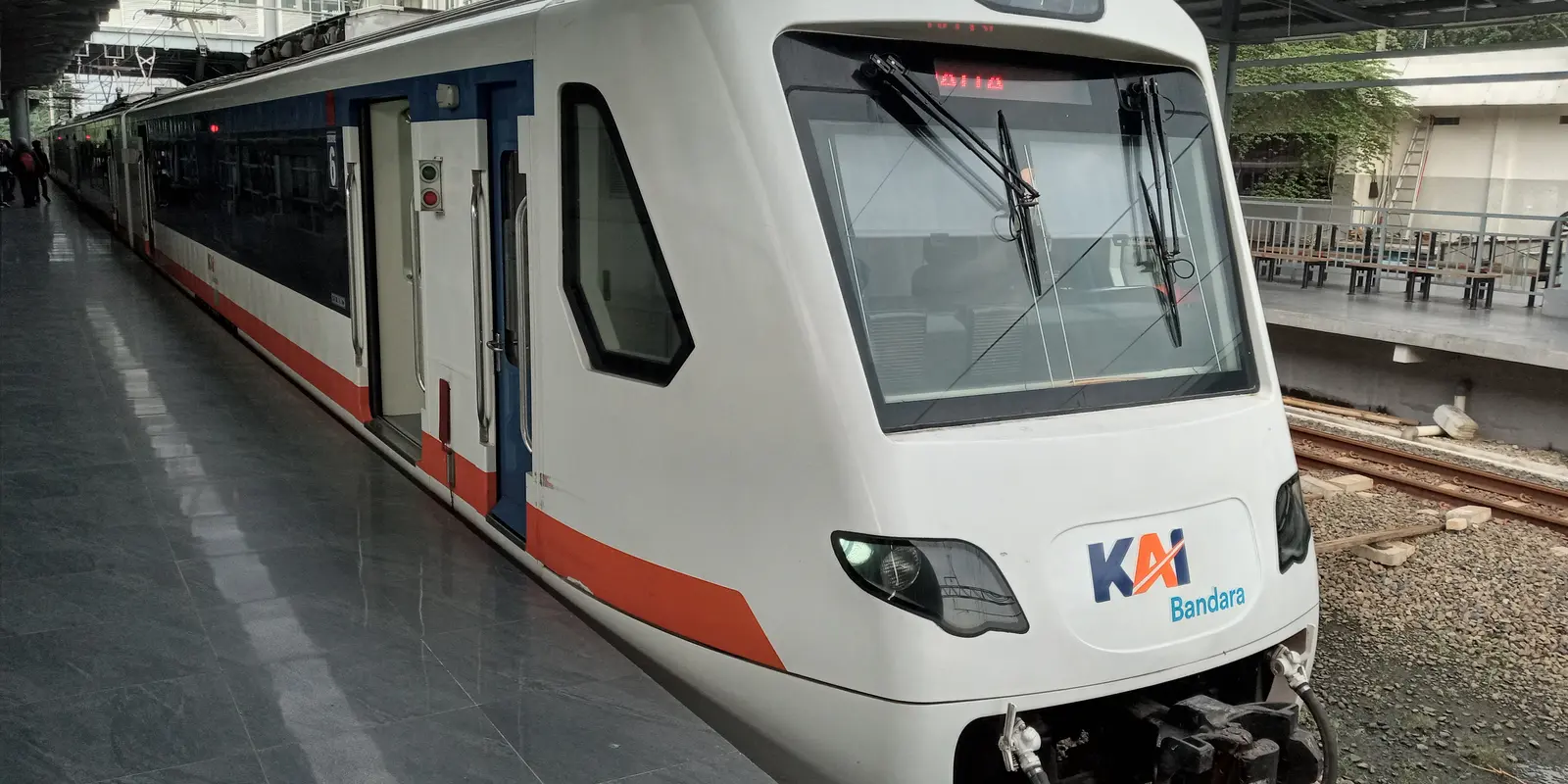
KAI Commuter reported an indication of vandalism to signalling equipment between Batu Ceper Station and Soekarno-Hatta Airport Station early on Monday 21 September. Both the Commuter Line Basoetta, the train that runs into the airport, and the Commuter Line Tangerang–Duri were delayed as a result. A day later the operator has still not said the fault is fixed, and no outlet we can find has reported the line back to normal — but nor has anyone reported it still broken. Treat the train as usable but unproven: if your flight matters, add at least an hour or take a road option. Check the live departures board for your flight, which is a separate question entirely.
Your flight is fine. Your train to it might not be. On the morning of Monday 21 September 2026, KAI Commuter announced that signalling equipment on the stretch of line between Batu Ceper and Soekarno-Hatta Airport had apparently been vandalised, and that trains on both the airport line and the Tangerang–Duri commuter line were running late as a result. Nothing about this touches aircraft, runways or airspace — it is a problem with getting to the terminal, which is the kind of problem that makes people miss flights just as effectively.
What KAI Commuter actually said
The operator posted the notice on its @CommuterLine social accounts on Monday morning. The wording, reproduced identically by Kompas.com, detikcom, CNN Indonesia and Liputan6, was: “Mohon maaf atas keterlambatan perjalanan Commuter Line lintas Tangerang-Duri PP dan Commuter Line Basoetta dampak adanya indikasi vandalisme pada perangkat persinyalan di antara Stasiun Batu Ceper - Bandara Soekarno Hatta” — an apology for delays to the Tangerang–Duri and Basoetta services caused by an indication of vandalism to signalling equipment between Batu Ceper and Soekarno-Hatta Airport stations.
Three things in that sentence are worth reading carefully. Keterlambatan means delays, not cancellations: the trains were still moving. Indikasi vandalisme is hedged language — an indication, not a finding. And the location, between Batu Ceper and the airport, is the final branch of the line, the stretch that exists only to serve Soekarno-Hatta.
KAI Commuter said the fault meant trains at the affected location had to change which tracks they used entering and leaving stations, asked passengers to follow instructions from staff on the ground, and said it would issue updates as the situation developed. It did not give a recovery time.
Reports differ slightly on when the notice went out. CNN Indonesia timed it at 06:38 WIB; Kompas.com published at 07:14 WIB, detikcom at 07:26 WIB and Liputan6 at 08:20 WIB. None of them gives the time the damage itself was discovered, so the disruption may have begun earlier than any of those timestamps.
Why a signal fault slows two different lines
The Basoetta line runs Manggarai – BNI City – Duri – Rawa Buaya – Batu Ceper – Soekarno-Hatta Airport. The Tangerang–Duri commuter line runs out to Tangerang and also calls at Batu Ceper. The two share the corridor from Duri, and Batu Ceper is the junction where the airport branch peels off.
Signalling is what lets a controller set a route through that junction and know it is safe before a train is allowed onto it. When it is unavailable, the work does not stop — it gets done by hand, with staff setting and confirming routes and trains proceeding under restricted authority. That is slower, and the delay accumulates across every train that follows. It is why one damaged installation on a short branch line degrades the timetable on a service that does not even use that branch.
This is also, for what it is worth, the argument for the airport train in normal conditions: it is the one route to CGK that is immune to Jakarta’s traffic. On Monday, the immunity ran the other way.
There were already fewer trains than there used to be
This matters more than it sounds. On Thursday 10 September 2026, eleven days before the signalling fault, KAI Commuter cut the Basoetta timetable from 70 services a day to 52 — eighteen fewer. Karina Amanda, the operator’s VP Corporate Secretary, said the airport trainsets had been moved to cover the Tanjung Priok route, with the Tanjung Priok sets going on to Bogor. detikcom and iNews both reported the change on the day.
From Manggarai the departures are now roughly two-hourly — 05:30, 07:30, 09:30 and on through 21:30, with airport-to-Manggarai workings at 06:27, 08:27 and so on. The practical consequence is that the cost of missing your train has gone up. On a half-hourly service a missed connection is an annoyance; on a two-hourly one it can be the flight. Add a delay of unknown length on top of a two-hour gap and the margin disappears quickly.
If you see an older guide quoting 62 daily Basoetta services — a figure ANTARA published in October 2024, and one that is still widely repeated — it is out of date. Check the actual departure times in the C-Access or Access by KAI app rather than assuming a train will be along shortly.
Getting to CGK while the train is unreliable
| Option | Fare | Journey time | Status, 22 September |
|---|---|---|---|
| Commuter Line Basoetta (airport train) | Rp 70,000 from Manggarai, BNI City or Duri; Rp 35,000 from Rawa Buaya or Batu Ceper | 46–52 min from BNI City when running normally | Delayed Monday. No all-clear announced since. |
| DAMRI airport bus | Around Rp 80,000 from Gambir or Blok M | 1–2 hours, traffic-dependent | Unaffected by the signalling fault |
| TransJakarta SH1 (Kalideres) / SH2 (Blok M) | Rp 3,500 flat | Slowest option; add a shuttle or walk at the airport end | Unaffected by the signalling fault |
| Blue Bird taxi or ride-hail | Roughly Rp 150,000–300,000 from central Jakarta | 45 min–2 hours, traffic-dependent | Unaffected by the signalling fault |
Basoetta fares are KAI Commuter’s published tariff; the operator currently runs 52 airport services a day. The road fares are the ones in our airport-to-city transport guide, which compares all of these in more detail.
The honest summary: a signalling fault cannot touch a bus or a taxi, so every road option is as reliable today as it was last week — which, in Jakarta on a Monday morning, is not a guarantee of anything either. If you move to the road, move your departure time with it.
- If you are already at a station, the trains are running. Ask staff on the platform rather than guessing from the app, and if you are delayed by more than 15 minutes, Customer Service at your destination station will issue a delay letter.
- If you were planning the cheap route — Tangerang line to Batu Ceper, then Rp 35,000 for the last leg — both halves of it are affected. Budget generously or take TransJakarta SH1 or SH2 at Rp 3,500 instead.
- If you reach the Airport Railway Station, the free Kalayang Skytrain to Terminals 1, 2 and 3 is a separate system inside the airport and is not involved in this.
- Check before you commit. KAI Commuter posts updates on its own channels as conditions change, and it is the only source that will know when the line is normal again.
What is not known
A good deal, and it is worth being clear about it. No source we found says what was damaged — cabling, a signal head, a relay cabinet — or when the damage was discovered. There is no police statement, no arrest and no stated motive; KAI Commuter itself says only that there is an “indication” of vandalism, which leaves room for the cause to turn out to be something else. No operator or outlet has published how late trains were actually running, how many services were affected, or when normal operations are expected to resume.
A day on, that has not improved. As of Tuesday 22 September 2026 we can find no follow-up reporting at all — no announcement from KAI Commuter that the fault is repaired, no police statement, and no outlet revisiting the story. Absence of news is not the same as an all-clear: it is equally consistent with the line having quietly returned to normal on Monday and with the repair still being in progress. We are not going to guess which.
For context rather than connection: signalling equipment on lines in the Tangerang area has been targeted before. ANTARA Banten reported that on 8 May 2026 axle-counter cabling was stolen near Daru station on the Tangerang–Parung Panjang line, and that Polresta Tangerang opened an investigation. That was a different incident on a different line, and nothing published links it to this one — but it is why cable and signalling theft is a recurring problem rather than a freak event.
We will update this article when KAI Commuter announces that the line is back to normal, or when any of the above is confirmed.
FAQ
Has the line been fixed?
Not that anyone has said. KAI Commuter announced the fault on Monday 21 September 2026 but has not announced a repair, and as of Tuesday 22 September we can find no follow-up reporting in any outlet. That silence cuts both ways — the line may well have returned to normal on Monday, but nobody has confirmed it. Until someone does, plan as though the train could still be delayed.
Are flights at Jakarta Airport (CGK) affected?
No. This is a railway signalling problem on the line into the airport, not an airport or airspace problem. Nothing in KAI Commuter’s notice or in the reporting touches flight operations, and no airport or airline statement has been issued about it. Check the live departures board before you leave, as you would on any day.
Is the airport train cancelled?
No — KAI Commuter described the effect as keterlambatan, delays, not cancellations. Commuter Line Basoetta trains were still running on Monday morning 21 September 2026, but slowly, because the signalling fault forced staff to change which tracks trains use entering and leaving stations in the affected section. No operator or news report we found gave a figure for how many minutes late trains were running.
What exactly was damaged?
KAI Commuter said only that there was an “indication of vandalism to signalling equipment between Batu Ceper Station and Soekarno-Hatta Airport Station”. It did not say what was damaged, when the damage was found, or who it thinks was responsible. We found no police statement and no arrest reported. Treat any more specific account as unconfirmed.
How do I get to CGK if I do not want to risk the train?
Road options are unaffected by a rail signalling fault: DAMRI airport buses from Gambir, Blok M and other Jakarta points at around Rp 80,000; TransJakarta routes SH1 to Kalideres and SH2 to Blok M at the flat Rp 3,500 fare; and Blue Bird taxis or ride-hail at roughly Rp 150,000 to Rp 300,000 from central Jakarta. Jakarta traffic is the variable there, not signalling, so build in more time than the train would have needed.
Does this affect the Kalayang Skytrain inside the airport?
The Kalayang is a separate automated people mover inside the airport perimeter, connecting Terminals 1, 2 and 3 with the Airport Railway Station. It does not use the mainline signalling that was damaged, and no report mentions it. If you arrive at the railway station, the Kalayang is how you reach your terminal from there.
Can I get compensation if the train makes me late?
KAI Commuter says passengers delayed more than 15 minutes by an operational disruption can ask Customer Service at their destination station for a surat keterlambatan — a delay letter. That is a document confirming the delay, useful for an employer or an insurer. It is not a refund, and it does not oblige an airline to rebook you. If you miss a flight because of a ground-transport delay, that is between you and your airline, and most tickets give you no right to anything.
The Tangerang–Duri line does not go to the airport. Why is it in the story?
Because Batu Ceper is where the airport branch leaves the Tangerang line, and the two share the corridor from Duri outwards. A signalling fault on the approach to the airport forces manual route-setting at the junction, which slows both services. It also matters for travellers who reach the airport the cheap way — Tangerang line to Batu Ceper, then Rp 35,000 for the last leg. On Monday morning both halves of that trip were delayed.
How much extra time should I allow?
With no all-clear announced, we would not rely on the train for a flight with a tight margin. If you use it anyway, treat the published 46–52 minute journey as a best case and add at least an hour. Check the actual departure time first: since 10 September 2026 the Basoetta timetable has been cut to 52 services a day, roughly two-hourly from Manggarai, so missing one costs far more than it used to. If you switch to the road, leave earlier than the train would have required — two and a half to three hours before an international departure is a reasonable target from central Jakarta in the morning peak.
See also
- Live departures and live arrivals — the fastest way to check your own flight.
- Airport-to-city transport guide — train, DAMRI, TransJakarta, taxi and ride-hail compared, with fares.
- Jakarta transport tips — e-money cards, KRL and TransJakarta for visitors.
- Kalayang Skytrain — the free people mover between the Airport Railway Station and Terminals 1, 2 and 3.
- Terminals & services — where to wait if you arrive early after leaving extra time.