Why Was My Flight Cancelled? Indonesia’s Rules and CGK Data
The short version: if your flight is cancelled, you are owed the next flight or a full refund, whatever the reason.
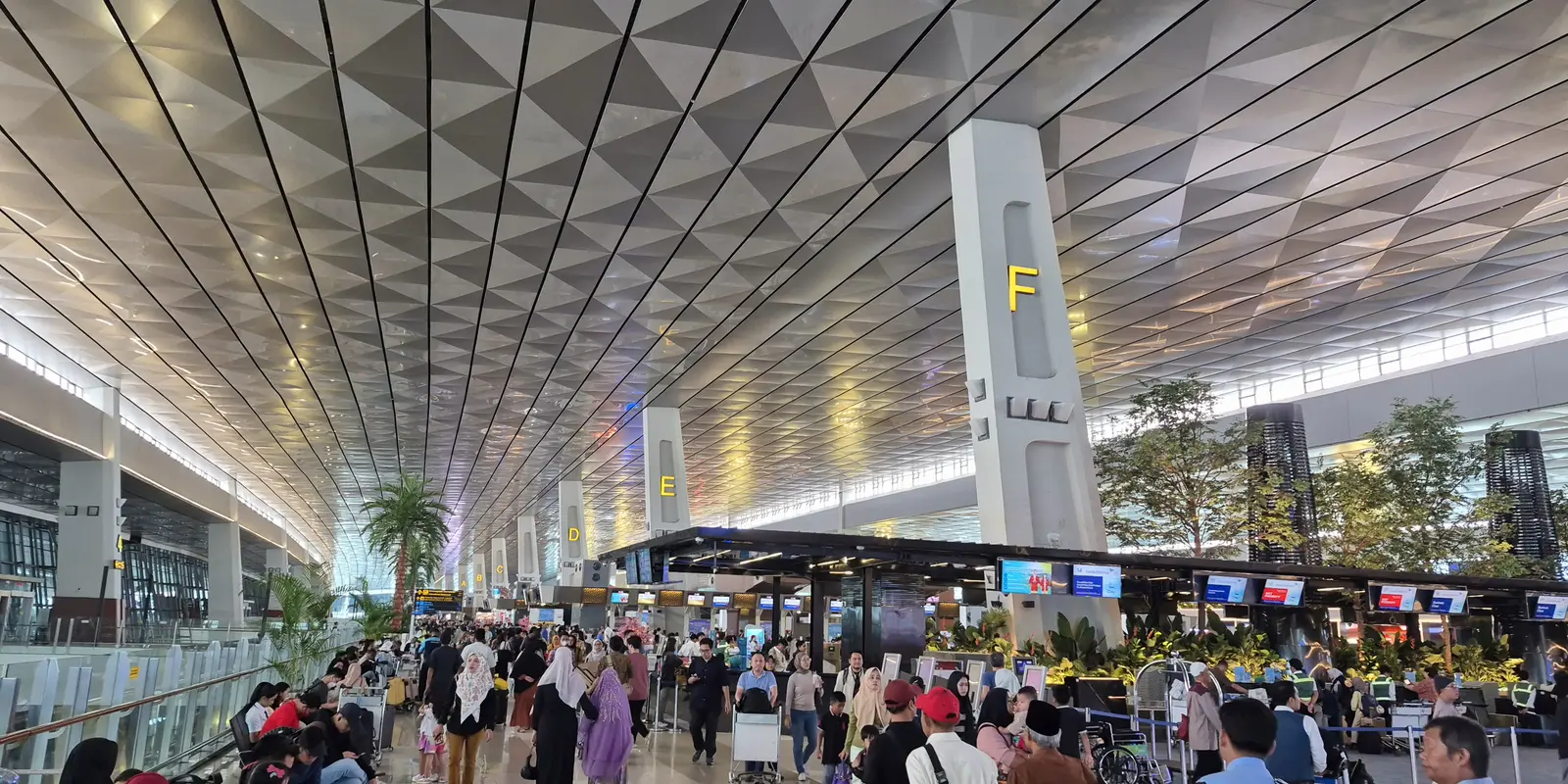
The airline must tell you of a cancellation at least 7 calendar days before the flight. Today at CGK, the airport’s board showed 51 of 344 remaining departures as cancelled at 10:03 WIB on Monday 5 October 2026 — details below. Check your own flight on the live departures board.
A cancelled flight is not a late one: it will not operate at all, and you have to be put on another flight or given your money back. Why flights in Indonesia get cancelled usually comes down to one of a few things — weather at either end of the route, volcanic ash or another airport closure, a problem with the aircraft or crew, or a commercial decision by the airline, such as folding a lightly booked flight into another one on the same route. This guide explains each cause, what the rules say about them, what this week looked like at Jakarta’s Soekarno-Hatta airport (CGK), and what to do if it happens to you.
What a cancellation means for you
Indonesia’s passenger-rights rule for delays and cancellations is Transport Minister Regulation PM 89 of 2015. It treats a cancellation as category 6, the last of its six categories, and gives you a choice: the airline’s next flight, or a full refund of the ticket (Article 9). That applies whatever the cause — weather and airport problems free an airline from delay compensation such as meals and the Rp 300,000 payment, but not from rebooking or refunding you.
The airline also has to warn you in advance. Article 7 says a cancellation must be notified no later than 7 calendar days before the flight, and a change of departure time no later than 24 hours before. The full detail of what you are owed for each kind of delay is in our flight delay compensation guide.
1. Weather: storms, haze and low visibility
Weather is the cause the Transport Ministry names most often. In May 2025 the Director General of Civil Aviation, Lukman F. Laisa, told parliament that weather was the most dominant of the causes of disruption to domestic flights. An aircraft cannot land when visibility at the destination is below the minimum for the approach, and an airline may cancel rather than send a flight that is likely to have to turn back.
Forest-fire haze is the big one in the dry season, and it usually hits the far end of the route, not Jakarta. On 13 September 2026, 22 flights between CGK and Kalimantan were cancelled as haze closed in on Pontianak and Palangkaraya; see why CGK flights keep getting delayed and cancelled. At Pontianak in early September, Lion Air Group cancelled Batik Air, Lion Air and Super Air Jet flights and described the haze as force majeure, according to Liputan6.
Haze has also been disrupting southern Sumatra this month. On 1 October haze disrupted 12 flights at Palembang’s Sultan Mahmud Badaruddin II airport and delayed 6 at Jambi, according to detik; on 3 October Palembang’s general manager, Ahmad Syaugi Shahab, said eight flights were delayed with visibility at 600 metres, one of them a Citilink flight from Jakarta that had to return to base (Antara); and on 4 October he put the number of disrupted flights at 31, through delays and diversions (SuaraSumsel, JPNN). Reports for those days describe delays, diversions and returns rather than cancellations. Haze also turned a CGK–Jambi flight back to Jakarta on 30 September; see haze turns a CGK–Jambi flight back.
Thunderstorms around Jakarta more often cause delays and diversions than cancellations; our guide to why flights get delayed covers them.
2. Volcanic ash and airport closures
When an airport closes, every flight to or from it during the closure is cancelled or diverted. Ash from Anak Krakatau shut Soekarno-Hatta and seven other airports in September 2026, disrupting up to 4,174 flights; the Transport Minister ordered airlines to offer a 100% refund or rebooking. See the Anak Krakatau closure. Ash from Lewotobi Laki-laki in Flores did the same to Bali in November 2024: on 13 November, 115 flights at Ngurah Rai were cancelled because of the eruption, according to the airport’s then general manager, quoted by detikNews.
PM 89 classes an airport that cannot be used — ash, a flooded or damaged runway — as a “technical operational” factor outside the airline’s control. You are still owed the next flight or a refund.
3. Technical and crew problems
If a fault turns up during pre-flight checks and cannot be fixed or signed off in time, the aircraft does not fly. A delay can turn into a cancellation when there is no spare aircraft, or when the crew runs out of legal duty time while waiting. How much slack an airline has depends on how many of its aircraft are serviceable: in May 2025 Garuda Indonesia said 15 of its group’s aircraft (14 of them Citilink’s) were grounded awaiting heavy maintenance and parts, citing supply-chain constraints, according to Kompas.
Under PM 89, an aircraft that is “not ready” and late crew are the airline’s own responsibility, not an excused cause.
4. Commercial decisions: merging lightly booked flights
The cause airlines talk about least is commercial. When two flights on the same route are lightly booked, an airline can cancel one and move its passengers onto the other. In Indonesian this is called penggabungan penerbangan — merging flights.
It has been described on the record. When Jakarta’s Halim Perdanakusuma airport reopened after the ash closure on 8 September 2026, its assistant manager for airside operations and landside service, Alyudha Heru Librawan, told Kompas that several Batik Air morning flights had been cancelled because they had few passengers, and the passengers moved to the next flight to the same destination — Batik Air 7511 to Surabaya into Batik Air 7517. He linked it to the sudden reopening: when airlines were not yet sure the airport would open, they tended to cancel lightly booked flights and combine them with later ones.
Passengers suspect it more often than airlines confirm it. In February 2026 the preacher Das’ad Latif, after a long delay, wrote on Instagram that the “leak” was that passengers were being combined into one flight “so the company does not lose money”, tagging the Transport Ministry’s 151 account, Lion Air Group, BPKN and YLKI. That was his allegation, not an established fact. Lion Air Group’s spokesman Danang Mandala Prihantoro told Beritasatu the group wanted to know which airline, route and flight was involved and would look into it. In April 2021 a member of parliament’s transport commission, Herson Mayulu, asked the minister to reprimand Batik Air, saying he had taken about five of its flights whose schedule was suddenly brought forward by an hour or cancelled (detikFinance); Lion Air Group said it took the criticism as input for evaluation, according to Bisnis.com.
Planned schedule cuts are related but different. After jet-fuel prices rose in 2026, airlines reduced frequencies on many domestic routes. The airline association INACA’s secretary general, Bayu Sutanto, said in May that airlines had cut and would cut frequencies and routes because of the low season, weaker demand and fuel prices, and Lukman F. Laisa confirmed several operators had done so, according to Kompas.id. A frequency cut planned weeks ahead and notified properly is a normal schedule change; the problem for passengers is a cut made at short notice.
We found no statement from YLKI, the Ombudsman or BPKN dealing specifically with merged flights, and no Transport Ministry warning aimed at the practice by name. The ministry has, though, written a rule about commercial cancellations (below).
How to tell if your flight was merged
You usually cannot know for sure — only the airline does. Signs that point to a commercial merge rather than weather or the airport:
- You are moved to another flight by the same airline, on the same route, the same day, a few hours earlier or later.
- The notice comes days or hours before departure, not a week or more.
- No weather or airport reason is given — just “operational reasons” or a schedule change.
- Other airlines’ flights on the same route that day operate normally on the departures board.
A technical or crew problem can look the same from the outside, so ask the airline for the reason in writing and keep its answer.
What the rules actually say
No rule forbids cancelling or merging flights. We found nothing in PM 89 of 2015 or the Aviation Law (Law 1 of 2009) that stops an airline from cancelling a flight for commercial reasons. What the rules do is attach conditions.
- Notice: 7 days for a cancellation, 24 hours for a time change. Article 7(3) of PM 89 requires the airline to inform passengers of a cancellation, by phone, text or announcement, no later than 7 calendar days before the flight, and of a reschedule no later than 24 hours before. A merge announced with less than 7 days’ notice does not comply with that notice rule. PM 89 does not set an extra payment for late notice, so what you are owed is still the next flight or a full refund — but the breach is worth putting in your complaint.
- Next flight or full refund (Article 9). If you take the next flight you pay nothing extra, even if it is in a higher class; if you are moved down a class, the difference is refunded (Article 10).
- Refund timing (Article 10). A ticket paid in cash is refunded in cash when you report to the airline; a ticket paid by credit card is refunded to the card within 30 calendar days. The articles do not name other payment methods; our compensation guide explains how the regulation’s own checklist treats them.
- Commercial reasons are not an excused cause. PM 89 excuses airlines from delay compensation only for weather, airport and air-traffic (“technical operational”) factors and “other” events such as riots (Article 5). Low bookings are not on that list.
Schedule approval and slots do constrain repeated cancellations. Transport Minister Regulation PM 2 of 2025, which amended the air-transport rules in January 2025, says scheduled airlines “must operate flights according to the schedule” in their approved route plan (Article 33). Every 14 calendar days the airport authority counts, for each route and flight number, the flights not operated or not operated as approved “for commercial reasons and/or airline management factors” (Article 34B). Routes served by only one airline, or flown under a government arrangement, are excluded. If the share reaches 20% or more, the Director General cuts the airline’s frequency or revokes the route, and the slot is withdrawn (Article 34C); the airline cannot reapply for six months (Article 34D). Passengers booked on flights removed this way must be told within 7 days and refunded — within 7 days for cash, 30 days for card or other non-cash payment (Article 34E).
The ministry says it enforces this. In October 2025 Lukman F. Laisa told Kompas that a slot not used for two weeks is revoked, and that 651 slots had been withdrawn between May and July 2025. He did not say how many of those related to cancelled flights rather than slots never used.
A challenge to the delay articles of the Aviation Law is before the Constitutional Court (case 190/PUU-XXIV/2026). Its final hearing was on 21 September 2026 and no ruling had been reported by 5 October. It concerns delay compensation, not cancellation notice, so it does not change anything in this guide for now.
This week at CGK: Monday 5 October 2026
This section is a snapshot, not a cancellation rate. At 10:03 WIB on Monday 5 October 2026, the airport’s own departures board listed 344 departures scheduled between 09:35 and 22:00 and marked 51 of them cancelled (15%). Flights that had already left were no longer on the board. An earlier reading at about 09:50 WIB showed the same 51 cancellations out of 352 flights listed.
| Airline | Cancelled | Listed | Share |
|---|---|---|---|
| Batik Air | 12 | 35 | 34% |
| Super Air Jet | 11 | 20 | 55% |
| Lion Air | 8 | 11 | 73% |
| Batik Air Malaysia | 6 | 6 | 100% |
| Citilink | 5 | 27 | 19% |
| TransNusa | 4 | 14 | 29% |
| Pelita Air | 1 | 14 | 7% |
| Garuda Indonesia | 1 | 49 | 2% |
| Sriwijaya Air | 1 | 2 | 50% |
| Cargo operators (Cargolux, My Indo Airlines) | 2 | 3 | 67% |
Source: CGK departures board, 10:03 WIB on Monday 5 October 2026, departures from 09:35 to 22:00 WIB. “Listed” counts the airline’s flights still on the board at that time, so small numbers swing the percentages a lot. Airlines not shown had no cancellations.
Where the cancelled flights were going. 21 of the 51 were to airports in Sumatra and Kalimantan — Pontianak (4), Padang (3), Jambi, Pekanbaru, Palembang, Palangkaraya and Banjarmasin (2 each), and Bengkulu, Pangkal Pinang, Bandar Lampung and Singkawang (1 each) — during a haze episode that has been disrupting flights in southern Sumatra since 1 October. The other 28 passenger flights were to Medan (5), Kuala Lumpur (4), Semarang, Solo, Bali, Lombok, Makassar, Balikpapan and Penang (2 each), Surabaya, Batam, Singapore, Jeddah and Shanghai (1 each). Two were cargo flights.
We have not seen an airline statement giving the reason for any of today’s cancellations. For the Sumatra and Kalimantan flights, haze is the likely context, though no airline has said so; for the others we found no public reason. The board shows only that a flight is cancelled, not why, and it cannot tell a commercial merge from a technical or weather cancellation.
For current figures, see our airline punctuality tracker, which counts cancellations per airline from the airport operator’s own flight records, with history back to 11 January 2026, so its 30-day and 90-day cancellation rates are a fair guide. A single day’s numbers should still not be read as a general or permanent cancellation rate for any airline.
What to do when your flight is cancelled
- Choose: next flight or full refund. Tell the airline which you want. You do not have to accept a voucher or a flight days later if you would rather have your money back.
- Ask why, and get it in writing. Ask whether the cause was weather, the airport, the aircraft or a schedule change. Screenshot the notice and note who you spoke to.
- Check when you were told. Note the date and time of the first message about the cancellation. If it was less than 7 days before the flight, say so in any complaint.
- Keep the evidence: booking confirmation, the airline’s messages, a screenshot of your flight on the departures board, and receipts for any costs.
- Booked through an agent? Ask the agent too; refunds often go back through whoever sold the ticket.
- If the airline does not resolve it, complain:
- Ministry of Transport Contact Center 151 — call 151, WhatsApp 0811 2011 151, or [email protected].
- Airport Authority Region I (Otoritas Bandar Udara Wilayah I), which supervises CGK — WhatsApp 0811-1980-2314 or [email protected].
- SP4N-LAPOR! at lapor.go.id for a tracked complaint.
- Consumer bodies: BPKN (153), YLKI (after a written complaint to the airline), or the BPSK consumer dispute body in your city.
Airline contact routes and the full complaint process are in the compensation guide.
What is not known
Indonesia does not publish how many flights are cancelled, by airline or by cause, so there is no official figure for how often flights are merged for commercial reasons. The ministry has not published how many routes or frequencies it has cut under the 20% rule since January 2025. And no airline has given a reason for the cancellations on the CGK board today.
FAQ
What does it mean when a flight is cancelled?
It means the flight you booked will not operate at all — not that it is late. Under Transport Minister Regulation PM 89 of 2015 a cancellation is “category 6”, and the airline must either move you to its next flight or refund the whole ticket. In Indonesia people often say “pesawat cancel”; it means the same thing.
Why was my flight cancelled?
The usual reasons are weather (storms, low visibility, forest-fire haze), volcanic ash, an airport closure, a technical problem with the aircraft, crew running out of legal duty hours, or a commercial decision — for example an airline cancelling a lightly booked flight and moving its passengers onto another flight on the same route. Only the airline knows which applies to your flight, so ask it for the reason, ideally in writing.
Are airlines allowed to merge flights with few passengers?
No regulation we have found forbids an airline from cancelling a flight and moving its passengers to another one. But the rules attach conditions. PM 89 of 2015 says passengers must be told of a cancellation at least 7 calendar days before the flight, and you are owed the next flight or a full refund. Separately, under PM 2 of 2025, if an airline fails to operate 20% or more of its approved flights on a route for commercial or management reasons, the Director General of Civil Aviation cuts its frequencies or revokes the route.
How many days before must an airline tell me about a cancellation?
At least 7 calendar days before the flight, by phone, text message or announcement, under Article 7 of PM 89 of 2015. A change to the departure time (a reschedule) must be notified at least 24 hours before. A cancellation announced on the day, or a few days before, for a reason within the airline’s control does not meet that notice rule.
What are my rights if my flight is cancelled?
You choose between the airline’s next flight and a full refund of the ticket, whatever the cause. If you are moved to another flight you pay nothing extra, even in a higher class; if you are moved to a lower class the difference is refunded. Cash tickets are refunded in cash when you report to the airline; credit-card tickets within 30 calendar days. The Rp 300,000 payment in PM 89 is for delays of more than four hours, not for cancellations.
Is there compensation if my flight is cancelled because of bad weather?
You still get the next flight or a full refund. Weather, airport and other outside causes free the airline only from delay compensation such as meals and the Rp 300,000, not from rebooking or refunding a cancelled flight.
Why are so many flights cancelled at CGK today?
Check the live departures board and your airline’s app. On Monday 5 October 2026 at 10:03 WIB the board showed 51 of 344 remaining departures as cancelled; 21 of them were to Sumatra and Kalimantan airports, where forest-fire haze has been disrupting flights. For the rest we found no public explanation. Our airline tracker shows current cancellation counts per airline.
Where can I complain about a cancelled flight?
First to the airline, in writing. If it does not resolve it, to the Ministry of Transport’s Contact Center 151 (call 151, WhatsApp 0811 2011 151, or [email protected]), to the Airport Authority Region I office that supervises CGK, or through SP4N-LAPOR! at lapor.go.id. For a consumer dispute you can also go to BPKN (153), YLKI, or the BPSK consumer dispute body in your city.
See also
- Flight delay compensation in Indonesia — what you are owed, and how to claim it.
- Why flights get delayed in Indonesia — the causes of delay at CGK.
- Airline punctuality at CGK — the live tracker, including cancellations.
- Why CGK flights keep getting cancelled — haze and ash in 2026.
- Live departures and live arrivals — the status of your flight today.