Which Airlines Are On Time at Jakarta Airport (CGK)? Live Tracker
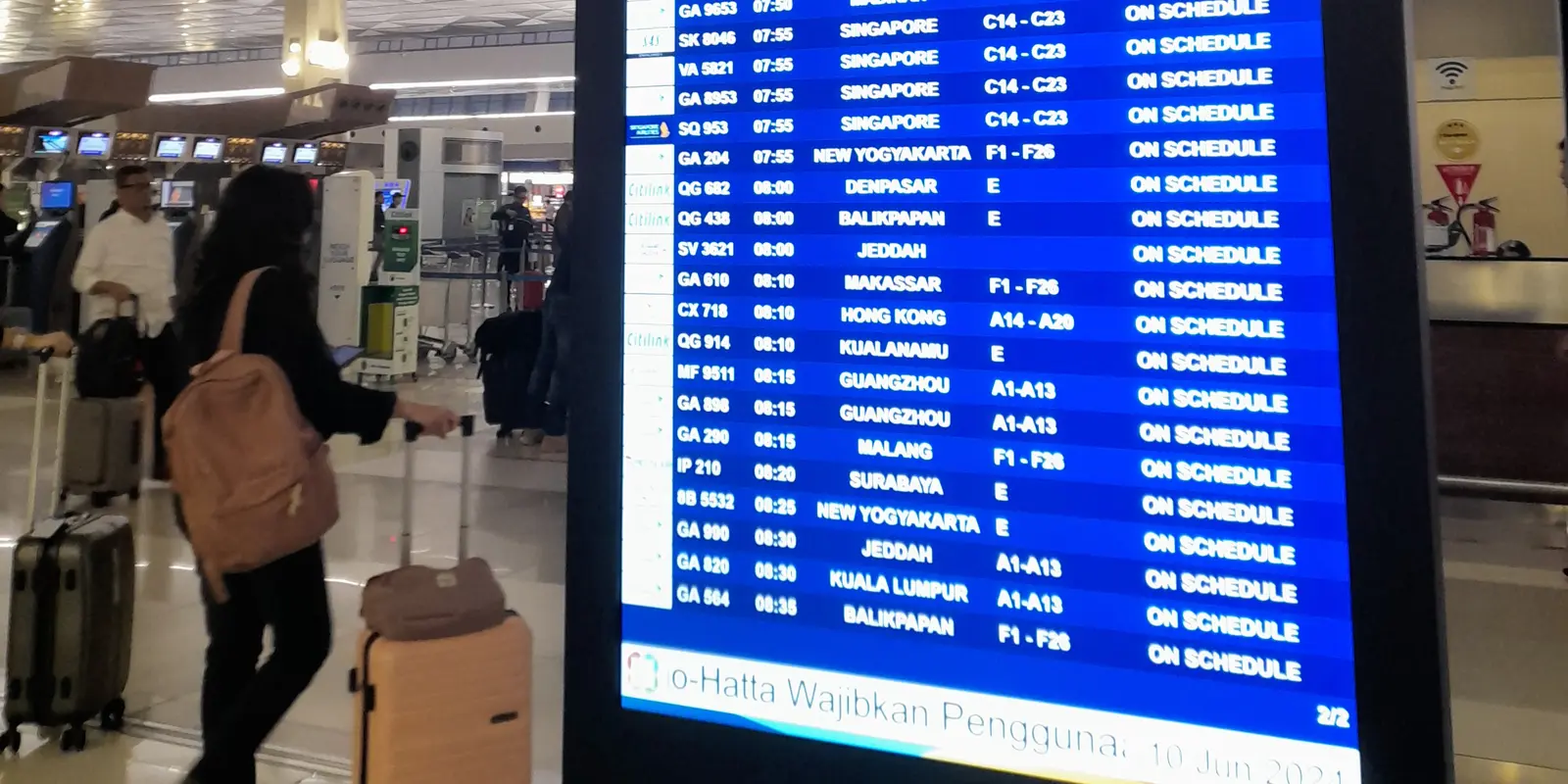
The tracker holds every CGK flight since 11 January 2026, from the airport operator’s own flight records.
That is enough history for the 30-day and 90-day views to be real rankings. This article still names no airline, because the answer changes from month to month; for the current numbers, go to the live punctuality ranking.
Which airlines are actually on time at Jakarta’s Soekarno-Hatta airport? Until now the only answers came a few times a year from the Transport Ministry, or from the airlines’ own marketing. We now publish a free, live measure of on-time performance for every airline at CGK, built from the airport operator’s own flight records, for every flight since 11 January 2026 — not from anything the airlines tell us. This guide explains what it shows, how to read it without being misled, how to use it before you book, and what Indonesian rules say you are owed when your flight is late.
What the tracker shows
The airline punctuality page ranks every airline flying at CGK by the share of its flights that were on time. Next to that rate it shows the average delay, the share of flights more than an hour late, the cancellation rate, and a coverage figure that tells you how complete the data is for that airline. Above the table, a day-by-day chart shows the on-time share across all airlines.
Two switches change what you are looking at. Direction flips between departures from CGK and arrivals into it. Period chooses Yesterday, the last 7 days, the last 30 days (the default) or the last 90 days. There is also a month-by-month archive, starting with January 2026.
Each airline has its own page with its daily trend, its on-time rate by hour of the day, domestic versus international flights, its busiest routes from CGK, and a list of its ten longest delays in the period, each with flight number, route, scheduled and actual time. For the larger CGK carriers:
- Garuda Indonesia on-time performance
- Lion Air on-time performance
- Batik Air on-time performance
- Citilink on-time performance
- Super Air Jet on-time performance
- Indonesia AirAsia on-time performance
- Pelita Air on-time performance
- TransNusa on-time performance
Every airline page also links to that airline’s flights on today’s board, so you can go straight from its track record to the status of your own flight.
How to read it
On time means within 15 minutes of the original schedule. This is OTP15, the definition used across the airline industry. A flight that pushes back 14 minutes late is on time; one that leaves 16 minutes late is not. For departures the actual time is the take-off time the airport reports; for arrivals it is the landed or at-gate time.
The delay is measured against the schedule, never the estimate. When an airline re-times a flight during the day, the airport’s estimate moves with it, and a flight can then “leave on time” against its new estimate while being an hour behind the time on your ticket. The tracker ignores the estimate and always compares with the published schedule, so a re-timed flight still shows its full delay. That is the delay you actually experienced.
| Column | What it means |
|---|---|
| On time | Share of completed flights that left (or landed) no more than 15 minutes after the original schedule. |
| Avg delay | Mean positive delay across completed flights. Early flights count as zero, not as negative. |
| > 1 h late | Share of flights more than an hour behind schedule. Separates many small delays from a few very long ones. |
| Cancelled | Cancelled flights divided by every flight the airport listed for that airline. |
| Coverage | Share of the airline’s flights for which the airport reported a final outcome: departed, landed or cancelled. Marked “low” below 70%; with the current source it is rarely far from 100%. |
Average delay and “more than 1 hour late” answer different questions. An airline with lots of 20-minute delays and one with a handful of four-hour delays can end up with the same average. If you have a tight connection or a meeting on arrival, the “> 1 h late” column and the longest-delays list on the airline’s page tell you more than the average does.
Coverage tells you how much to trust the row. The airport does not report a final outcome — departed, landed or cancelled — for every single flight. Coverage is the share for which it did. With the current source it is close to 100% for almost every airline; below 70% the bar turns amber and is marked “low”, meaning the on-time rate rests on only part of that airline’s flights. Flights with no outcome are excluded rather than guessed at.
“Not ranked” means a small sample, not a bad airline. An airline needs at least 30 completed flights in the period to be ranked (10 in the Yesterday view). Smaller carriers and occasional foreign airlines are still listed with their figures, under a separate divider, because three flights cannot support a percentage.
Departures and arrivals are different measures. A departure delay is mostly about what happens at CGK: the inbound aircraft, boarding, the queue for the runway. An arrival delay into CGK mostly reflects the other airport and the flight in. If you are flying out of Jakarta, look at departures; if someone is collecting you, look at arrivals.
Two more details. Flights are credited to the marketing carrier on the flight record — the airline whose code is on your ticket — so a codeshare sold by one airline and flown by another counts for the seller. And today is never included, because its flights are still in progress.
How to use it before you book
- Compare the airlines on your route. Most CGK domestic routes have three or four carriers. Open each airline’s page and look at its “By route” table for your destination rather than its overall rate.
- Look at your time of day. Delays tend to build as aircraft fly several sectors in a row. The “By hour of day” chart on each airline page shows whether its early departures hold up better than its evening ones.
- Use the 30- or 90-day view. A single bad day — a storm, a closure at the destination — can swamp the 7-day and Yesterday figures. Those shorter views are for spotting a disruption, not choosing an airline.
- Check coverage before comparing. If one airline shows 95% coverage and another 60%, the comparison between them is weaker than the numbers suggest.
- On the day, use the live board. The track record tells you what usually happens; the live departures and live arrivals pages tell you what is happening to your flight now. Check your destination too: most recent CGK cancellations have been caused by conditions at the other end, as our report on CGK delays and cancellations in 2026 explains.
The official figures, and how they differ
The Ministry of Transport (Kemenhub), through its Directorate General of Civil Aviation, is the official source of airline on-time performance in Indonesia. It does not publish a single running figure; it releases numbers for particular periods, usually at a press conference or a parliamentary hearing.
The most recent national figure we could verify is for the Lebaran 2026 travel period. Transport Minister Dudy Purwagandhi said on 30 March 2026, as the ministry closed its Lebaran command post, that domestic flights had been 76.15% on time, according to TVRI and the government portal InfoPublik. A year earlier, Director General of Civil Aviation Lukman F. Laisa told the House transport committee (Komisi V DPR) on 22 May 2025 that domestic on-time performance for January to April had slipped from 79.73% in 2024 to 78.7% in 2025, as reported by Kompas, Detik and CNN Indonesia. He named weather as the biggest single cause, ahead of technical and operational problems and airline management. (Detik described the period as the first quarter; Kompas and CNN Indonesia, quoting him directly, say January to April.)
Kemenhub also hands out an annual award. At its Aviation Award 2026 on 2 September 2026, the ministry named Pelita Air the airline with the best on-time performance for 2026, according to Antara and Jawa Pos — the second year running. Neither report gives a percentage or ranks the other airlines, and we could not find a recent official full-year table of every airline’s on-time rate. If you see one quoted, check its year.
These figures are useful context, but they measure something different from this tracker:
| Ministry of Transport figures | This tracker | |
|---|---|---|
| Who publishes it | Ministry of Transport (Directorate General of Civil Aviation) | This site, independently |
| Where | Every airport an airline serves, nationwide | Soekarno-Hatta (CGK) only |
| How often | Set periods — Lebaran, year-end holidays, quarters — plus an annual award | Recalculated daily; collector runs several times an hour |
| Source of times | Airline and airport reports, reconciled by the regulator | The airport operator’s own flight records, nothing else |
| What you can see | One percentage per airline | Rate, average delay, > 1 hour late, cancellations, coverage, by hour and route |
Neither is the “true” number. The official figure is the better guide to an airline’s network as a whole; this tracker is the better guide to what happens at the airport you are actually flying from, and it shows the size of the delays, not just whether there was one.
If your flight is delayed: what Indonesian rules say you are owed
The tracker tells you how often an airline is late. What you are owed when it happens to you is set by Transport Minister Regulation PM 89 of 2015 on delay management for scheduled airlines, which is still in force. It uses its own scale: delays are measured from the aircraft leaving its stand (block-off), and the categories start at 30 minutes, not 15.
| Category | Delay | What the airline must provide |
|---|---|---|
| 1 | 30–60 minutes | A soft drink. |
| 2 | 61–120 minutes | A drink and a snack box. You may also take the next flight or a full refund. |
| 3 | 121–180 minutes | A drink and a heavy meal. Next flight or full refund. |
| 4 | 181–240 minutes | A drink, a snack box and a heavy meal. Next flight or full refund. |
| 5 | More than 240 minutes | Compensation of Rp 300,000. Next flight or full refund. Accommodation if the delay passes 6 hours and you need it. |
| 6 | Cancellation | A seat on the next flight or a full refund. |
A two-hour delay (up to 120 minutes) is category 2: a drink and a snack box, plus the right to switch to the next flight or take a full refund. From 121 minutes it becomes category 3, and the snack becomes a proper meal.
The Rp 300,000 is only for delays of more than four hours. The regulation says it can be paid in cash, as a voucher that can be cashed, or by bank transfer, no later than 3 × 24 hours after the delay. Airline staff are supposed to offer it without being asked. Rebooking onto another flight, including another airline, must not cost you extra; a refund on a card-paid ticket is due within 30 days.
The big exception is the cause. The airline owes all of this only when the delay is its own doing — what the regulation calls airline management factors: late crew, late catering or ground handling, waiting for connecting passengers, an aircraft not ready. It owes no compensation when the cause is weather (heavy rain, storms, fog, smoke or haze, visibility below minimum, strong wind), airport conditions (an airport or runway that cannot be used, queues for take-off or landing and slot allocation, late refuelling) or riots at the airport. For weather or technical causes the airline must be able to show an official letter from BMKG or the airport. That is why passengers caught by the 2026 haze and ash got refunds and rebooking, not Rp 300,000 — see our report on CGK delays and cancellations.
The tracker cannot tell you which side of that line your delay fell on; the airline has to. If you think you are owed something and the airline disagrees, Kemenhub’s complaint line is Contact Center 151.
What the tracker cannot tell you
- Why a flight was late. The records show times, not causes, so the tracker cannot separate weather from an airline problem — the distinction that decides compensation.
- Flights with no final status. A handful of flights never reach departed, landed or cancelled in the airport’s records. They are excluded, and their share is the coverage figure.
- Occasional schedule quirks. The airport sometimes lists a flight under an already-moved schedule, which can make a very late flight look early. Such rows are rare and are counted as zero delay, never negative.
- Gaps in the source. The airport’s records are missing almost all flights for 30 April to 3 May 2026, and the first two days of the history, 11 and 12 January, are partial. Periods that include those days rest on fewer flights. If the collector itself misses a run, the next run catches up, so a collection gap no longer loses flights.
The full rules are on the methodology page.
FAQ
Which airline is the most on time at Jakarta airport?
Check the live ranking at jakartaairportcgk.com/airlines/ — it is recalculated every time the page loads, and its history covers every CGK flight since 11 January 2026, so the 30-day and 90-day views are real rankings. This article deliberately does not name one airline, because the answer changes from month to month. Use the 90-day view for the steadiest comparison, and pick the direction — departures or arrivals — that matters to you.
Is Lion Air often delayed?
The Lion Air page at /airlines/jt/ shows its on-time rate, average delay, share of flights more than an hour late and its longest delays at CGK, by hour and by route. The same goes for Batik Air (/airlines/id/) and Citilink (/airlines/qg/). Those pages hold history from 11 January 2026, so the 30-day and 90-day views are a fair guide; this article leaves the verdict to them rather than quoting a number that will be out of date next month.
What counts as a delayed flight?
On the tracker, a flight is on time if it departs or lands no more than 15 minutes after its original published schedule — the industry-standard OTP15 measure. Anything later counts as late. The delay is always measured against the schedule, never the estimate, so a flight that is re-timed during the day still shows its full delay. Indonesian compensation rules use a different scale, starting at 30 minutes.
What do I get if my flight is delayed 2 hours?
Under Transport Minister Regulation PM 89 of 2015, a delay of 61 to 120 minutes is category 2: the airline must give you a drink and a snack box, and you may switch to the next flight or take a full refund. From 121 minutes it is category 3 and you are owed a heavy meal. None of this applies if the delay was caused by weather or airport conditions rather than the airline.
Do I get Rp 300,000 if my flight is delayed?
Only if the delay is more than four hours (category 5 under PM 89 of 2015) and was the airline’s own fault. The Rp 300,000 can be paid in cash, as a cashable voucher or by bank transfer within 3 × 24 hours, and staff are supposed to offer it unprompted. Delays caused by weather — including smoke and haze — or by airport conditions such as runway closures, take-off queues or late refuelling are excluded.
How often is the tracker updated?
The collector reads the airport operator’s flight records several times an hour. The rankings cover finished days only — today is always excluded because its flights are still in progress — so the figures move once a day, after midnight WIB, as yesterday is added.
Why is an airline marked "not ranked"?
Because it completed too few flights in the period for a percentage to mean anything. An airline needs at least 30 completed flights in the selected period to be ranked, or 10 in the single-day Yesterday view. Below that it is still listed, with its figures, under a "not ranked" divider.
Is this the same as the Transport Ministry’s on-time figures?
No. The Ministry of Transport publishes national figures for set periods, such as Lebaran, compiled from airline and airport reports across Indonesia. This tracker covers Soekarno-Hatta only, is recalculated daily, and is built solely from the airport operator’s own flight records. The two will not match, and neither is wrong for that reason.
See also
- Airline punctuality at CGK — the live ranking, departures and arrivals.
- How punctuality is measured — the source, the definitions and the known limitations.
- Live departures and live arrivals — the status of your flight today.
- Why CGK flights still get cancelled — the haze and volcanic ash behind most disruption in 2026, and refunds when a flight is cancelled.
- Terminals & services — where to wait, eat and charge if your departure slips.